|
The Olympic Games of Leni Riefenstahl
Few films have given rise to so strong discussions and for so long, as the film "Olympia" (1938) by the German Leni Riefenstahl, a film which was based 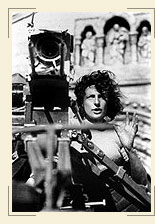 on material from the eleventh Olympic Games (Berlin 1936). This was the first official film recording of the Games, a practice that has been adopted since by the organizing committees. Among these "Olympic films", "Olympia" is one of the few that have been recognized as an original artistic creation, both as to its aesthetics and to the filming techniques that were used. At the same time, this film is regarded as the finest example of combining art with political propaganda in the interwar years. on material from the eleventh Olympic Games (Berlin 1936). This was the first official film recording of the Games, a practice that has been adopted since by the organizing committees. Among these "Olympic films", "Olympia" is one of the few that have been recognized as an original artistic creation, both as to its aesthetics and to the filming techniques that were used. At the same time, this film is regarded as the finest example of combining art with political propaganda in the interwar years.
Leni Riefenstahl's relation to cinema began in the mid-1920s. At that time she was starring in the films of Arnold Flank, a great German film-maker. Next to Flank she learnt the basic rules of the seventh art until the beginning of the 1930s, when she founded her own production company (1931) and made her first film, "Das Blaue Licht" (The blue light). Apart from the production of the film, she directed it and played in it. The film made a good impression and won the second prize in the film festival of Venice. That same year, Josef von Sternberg, the director who won worldwide renown in that year with the film "Blue Angel" and was preparing to move to Hollywood together with his heroine Marlene Dietrich, proposed to Riefenstahl to accompany him to the USA and work with him as an actress. At the same time, however, Adolph Hitler, impressed by her film, proposed to her to film the congress of the National Socialist Party that would be held in Nuremberg in 1933.
Of the two proposals Riefenstahl chose the latter, thus associating her artistic creation with the rise of the Nazis in Germany and the ascent of Hitler to power. Riefenstahl's first movie on the Nazi Party, the filming of the congress of 1933, was entitled "Sieg des Glaubens" (The victory of faith) and made no particular impression as to its artistic outcome. Things were different, though, when she filmed the congress of the following year. "Triumph des Willens" (The triumph of the will), as the film was entitled following Hitler's recommendation, won many international film prizes, among which the Golden Palm at the festival of Venice. Riefenhstahl's film was quite popular outside Germany as well, portraying Hitler's personality and the Third Reich in an attractive way.
Riefanstahl's success made Carl Diem (head of the organizing committee of the eleventh Olympic Games) propose to her to undertake the first official recording of the Games. The filming of an international sports event that was held in several different sites, with a great variety of contests (e.g. athletics and sailing), each one presenting its own difficulties in the effort to film the athletes, was a pioneering and therefore difficult undertaking. For the realization of this undertaking tens of film-makers and cameras were called into action and new techniques were used. Cameras were placed in particular locations in the competition site, adjusted to the needs of each contest, so that the entire effort of the athlete would be filmed from many different angles. For example for the filming of the diving events cameras were put on the surface of the water and on a level with the springboard, whereas a new cine camera was used for underwater takes. Other innovations were the use of slow motion, the construction of special towers for the coverage of the events and of the competition site from high and takes from an aeroplane. The techniques Riefenstahl used constituted the example for the television coverage of the sports meetings over the following decades
The material gathered from the filming of the 1936 Olympics had duration of more than 200 hours and it took almost 2 years for the production of the film to be completed. "Olympia" consists of two parts, each lasting two hours approximately. Riefenhstahl's new film won again the first prize in Venice, in the same year (1938) that Walt Disney's "Snow-White" competed in the same festival and was one of the most popular films throughout the world until 1939 and the outbreak of the war.
"Olympia" was Riefenstahl's last film, seeing that after the war and her definitive acquittal of the charges as to alleged collaboration with the Nazis, which happened in the mid-1950s, she chose the photographic camera instead of the cine camera. Therefore, her filmography consisted of only four films, three of which were identified with Hitler's Germany and the Nazis. Her film on the Olympic Games of 1936 is not a typical case of committed art. For example, no special emphasis is given to the victories of the German athletes, who won most of the medals anyway. Athletes from all countries are shown, irrespective of their nationality, the colour of their skin or their religion, with the African-American Jesse Owens and the Korean marathon winner Kitei Son holding a prominent place.
The propagandizing aspect of Riefenhstal's film lies in its harmonization with the policy pursued by the Nazis with regard to these Games and not in the adaptation for the cinema and the justification of the racist theories of the Nazi ideology. For the Nazis the Olympic Games were a first-class opportunity to show a powerful Germany, a Germany which under the leadership of Hitler was becoming so powerful that it could organize the most spectacular Games in the Olympic history. As a result, the eleventh Olympic Games became a privileged field of propaganda that showed - through the cine camera as well - the suitability of the stadiums, the splendour of the ceremonies, the supremacy of the German athletes, the torch relay, the celebrations and cultural events that were organized in Berlin.
In this context, Carl Diem got the idea of the torch relay, during which the Olympic flame would be carried from ancient Olympia to Berlin, as well as the idea for the first official filming of the Games. For the propaganda to be effective, the film had to appeal not only to the German but also to a wider public. Therefore, it had to be, above all, an original and prime artistic creation. Under these circumstances was Riefenstahl chosen and, indeed, the result lived up to everyone's expectations.
|