|
The women's Olympics
In 1936, after almost two decades of rivalry and negotiations, the International Association of Athletics Federations (IAAF) and the International Olympic 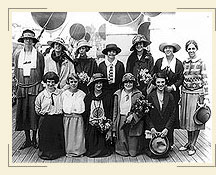 Federation managed to incorporate and hence control women's athletics, which from the early 1920s had been constituted through its own organizational structures and competitive institutions. The International Federation of Women's Sport (Federation Sportive Feminine Internationale - FSFI) was founded in October 1921 as a reaction to the refusal of the IOC to include in the programme of the Games women's contests in athletics and in other sports. The prime mover of the foundation of the FSFI was the French Alice Milliat. Prior to this, in May, a women's version of the Olympic Games had been organized in Monaco. Approximately 300 female athletes from five countries participated in these games, which included athletics events and basketball games. In the following year (1922) the FSFI organized in Paris the so-called Women Olympic Games. It was an international athletics meeting including 11 events in which participated approximately 2,000 female athletes from six countries, the USA and five European countries, and attended by 20,000 spectators. Four years later, in 1926, the second Women Olympic Games were held in Gothenburg, Sweden, with the support of the royal family. It was an organization characterized by splendid ceremonies and events and by impressive performances by the athletes. Federation managed to incorporate and hence control women's athletics, which from the early 1920s had been constituted through its own organizational structures and competitive institutions. The International Federation of Women's Sport (Federation Sportive Feminine Internationale - FSFI) was founded in October 1921 as a reaction to the refusal of the IOC to include in the programme of the Games women's contests in athletics and in other sports. The prime mover of the foundation of the FSFI was the French Alice Milliat. Prior to this, in May, a women's version of the Olympic Games had been organized in Monaco. Approximately 300 female athletes from five countries participated in these games, which included athletics events and basketball games. In the following year (1922) the FSFI organized in Paris the so-called Women Olympic Games. It was an international athletics meeting including 11 events in which participated approximately 2,000 female athletes from six countries, the USA and five European countries, and attended by 20,000 spectators. Four years later, in 1926, the second Women Olympic Games were held in Gothenburg, Sweden, with the support of the royal family. It was an organization characterized by splendid ceremonies and events and by impressive performances by the athletes.
The success of these games resulted in increasing pressures applied on the IOC, in order for it to include a full programme of women's athletics events. Indeed, these pressures led to negotiations between the IOC and the IAAF on the one hand and the FSFI on the other hand. The negotiations led to an agreement. The IOC assumed the responsibility to include 10 women's track and field events in the Olympics, whereas the FSFI committed itself not to use the words "Olympic Games" in the international sports meetings that it organized. However, the agreement was abided by only to a limited extent. In the Olympic Games of Amsterdam (1928) it was indeed the first time that women's track and field events were included, but they were half of the agreed number, namely five instead of ten. This resulted in the first "boycott" of the Games, seeing that many female track and field athletes refused to participate in them, especially the athletes from Great Britain, who had dominated most of the contests in Gothenburg. Nevertheless, the FSFI abided by its commitment. Therefore, the athletics games that were held in 1930 in Prague were given the name International Women's Games, an institution that was repeated in 1934 in London. These games were the last to be organized by the FSFI. The augmentation of the fascist and authoritarian governments in Europe created conditions that prohibited the promotion of women's claims, not only in sport, but also in all the fields of social life. Under these circumstances, the FSFI was incorporated into the IAAF in 1936.
The fifteen-year activity of the FSFI (1921-1936) followed the dynamic presence of the women's movement that was developed in Europe and in North America during the first decades of the 20th century. In this context of vindication of political and social rights by women and as the significance of sport and of the Olympics increased constantly in the modern world, the exclusion of women from the first modern Olympic Games (1896) and their limited participation in the following organizations were two of the central points in the action of the women's movement. The matter of contention was the participation of women in athletics. The appearance of women's track and field events from 1928 onwards, be it limited, was the result of the pressure exerted, to a large extent through the activity of the FSFI.
The decline of the women's movement from the end of World War II until the 1960s, when a second surge of claims by women was reported, is reflected in the minimal increase of women's sports in the programme of the Olympic Games between 1948 and 1968. However, since the 1970s, and especially in the 1980s and the 1990s the change has been spectacular, seeing that today women participate in almost all the sports that are included in the Olympic programme. Most specifically, in the Games of 2000, of the total of 28 sports included in the programme, women participated in 25 sports, whereas men participated in 27. This development is consequent to the unforeseen increase of both the number of female athletes who participate in the Games and of the number of countries they come from. However, this tendency is not reported inside the IOC, namely in the number of female members. It is characteristic that the participation of women in the IOC was not accepted before 1973 and the first woman member of the IOC was elected in 1981. Today, less than 10 women are in the IOC, a very small number compared with the almost 200 men.
The improvement of the position of women in both the private and public life, therefore in sport as well, from the beginning until the end of the 20th century, was the result of the social and political modernization that developed (and still develops) around the societies of Europe and North America, bringing about an improvement in women's living conditions and the mitigation of unfavourable discriminations. However, this development is not linear, nor does it appear in the same way and at the same time in all the latitudes and longitudes of the earth. The increase of the influence of the political Islam in several countries led to the official or tacit exclusion of women from the Olympic Games and the other international sports meetings. Iran, the only country that prohibits officially the presence and participation of men and women in the same sports games, organized in Tehran in 1992, namely the year of the Barcelona Olympics, a "Muslim" version of women's Olympics. Exactly seventy years after the organization of the "Olympic Games" by the FSFI in Paris (1922), the games held in Tehran concerned once again the position of women. In this case, however, the "request" was not the abrogation of the exclusion of women from the Olympic Games, but on the contrary, its endorsement.
|