|
 Valeriy
Borzov
Valeriy
Borzov
Among the 24 winners of the 100m event in the history of the Olympic Games, 15 are from the United States and only 5 come from some European 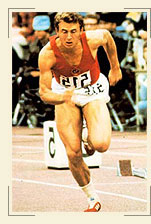 country: three British (Harold Abrahams 1924, Allan Wells 1980, Linford Christie 1992), one German (Armin Hary 1960) and one Soviet (Valeriy Borzov 1972). In the 200m, a contest that was introduced into the Games in 1900, among the 23 winners only four are from Europe: two Italian (Livio Berruti 1960, Pietro Mennea 1980), one Russian (Valeriy Borzov 1972) and one Greek (Kostas Kenteris 2000). In addition, of the 8 athletes who succeeded in winning a gold medal in the same Olympics, both in the 100m and the 200m, only one is from Europe: Borzov. country: three British (Harold Abrahams 1924, Allan Wells 1980, Linford Christie 1992), one German (Armin Hary 1960) and one Soviet (Valeriy Borzov 1972). In the 200m, a contest that was introduced into the Games in 1900, among the 23 winners only four are from Europe: two Italian (Livio Berruti 1960, Pietro Mennea 1980), one Russian (Valeriy Borzov 1972) and one Greek (Kostas Kenteris 2000). In addition, of the 8 athletes who succeeded in winning a gold medal in the same Olympics, both in the 100m and the 200m, only one is from Europe: Borzov.
This athlete was born on 20 October 1949 in the city Sambor in the Ukraine. He took up sport during his school years and started practising systematically in the end of the 1960s, when he was studying in Kiev, in the Institute of Physical Culture. There he entered a preparation programme that was based on the analysis of the techniques used by the speediest sprinters and especially the athletes from the USA. Soon there were results. In 1969 Borzov was first in the 100m in the European championship of outdoor athletics and second in the 60m in the equivalent championship of indoor athletics. He was the first athlete from the Soviet Union to excel in the sprints. Over the following years he became the greatest European sprinter of all times, winning twice the gold medal in the 100m (1971, 1974) and seven times in the 60m (1970-1972, 1974-1977) in the European championship of outdoor athletics and indoor athletics respectively.
Still, Borzov's greatest achievement took place in the Olympic Games of Munich, in 1972, when he won the gold medal in the 100m and the 200m prevailing by a considerable margin over the other runners. At the same time he participated with the team of the Soviet Union in the 4x100m relay and won the silver medal. Four years later, near the end of his career, he won the bronze medal in the 100m and in the 4x100m relay. Borzov's double victory in the 1972 Olympics caused sensation and constituted the object of propaganda in the context of the Cold War. Nevertheless, besides the rivalry of the two superpowers of that time, the victories of Borzov marked the "shrink" of the US athletes in events that were considered traditionally "theirs", such as the 100m and the 200m. It is characteristic that between 1896 and 1968 the athletes from the USA won 27 out of the 48 Olympic medals (12 gold, 11 silver, 4 bronze), i.e. 56,25% of the medals, whereas between 1972 and 2000 the percentage dropped to 29,1%, i.e. 7 medals out of 24. In the 200m the percentage before and after 1972 has been 66,6% (i.e. 30 out of the 45 medals) and 45,83% (i.e. 11 out of the 24 medals).
After the Montreal Olympics, Borzov was married to gymnast Ludmila Turisheva, a significant athlete, who, despite the 9 Olympic medals (4 gold, 3 silver, 2 bronze) in three Olympic Games (1968, 1972, 1976), remained in the shadow of Olga Korbut. In the early 1990s, when the Ukraine gained its independence, Borzov and Turisheva headed their country' s sports institutions.
|