|
 The
Games
The
Games
The
Games of Amsterdam lasted from 17 May until 12 August 1928.
Until 28 July, day of the official opening of the Games, had
been 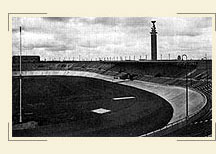 carried
out the preliminaries mostly, as well as field hockey. Two
important persons were absent from the opening ceremony in
the Olympic Stadium, which was filled to capacity: Pierre
de Coubertin, who from 1925 was simply honorary president
of the IOC (International Olympic Committee), and queen Vilhemine
of Netherlands, who in accordance with protocol would declare
the beginning of the Games as the leader of the host state.
Prince Hendrik was there instead of her, in a ceremony attended
by 40,000 spectators, while some thousands were outside the
stadium. The crowd outside the stadium was so large that the
Finnish athletes managed to enter for the parade by climbing
from the exterior of the stadium's tiers. carried
out the preliminaries mostly, as well as field hockey. Two
important persons were absent from the opening ceremony in
the Olympic Stadium, which was filled to capacity: Pierre
de Coubertin, who from 1925 was simply honorary president
of the IOC (International Olympic Committee), and queen Vilhemine
of Netherlands, who in accordance with protocol would declare
the beginning of the Games as the leader of the host state.
Prince Hendrik was there instead of her, in a ceremony attended
by 40,000 spectators, while some thousands were outside the
stadium. The crowd outside the stadium was so large that the
Finnish athletes managed to enter for the parade by climbing
from the exterior of the stadium's tiers.
Coubertin's absence was related to the presence of women -
for the first time in the history of the Olympic Games - in
athletics, whereas the queen's absence was related to a different
"presence", more precisely the Olympic flame. The Olympic
flame was first lit during the opening ceremony at the top
of the so-called Marathon Tower, which was placed at the entrance
of the stadium. That practice has been established since as
part of the organization's ceremony. The idea of the Olympic
flame, which referred to ceremonies of religious character
of the Greek Antiquity, had disturbed the queen, who denounced
it as pagan. The Olympic flame stayed lit throughout the Games,
whereas from the following organization (1936) the ritual
of the flame was complemented by the lighting ceremony in
Ancient Olympia and the torch relay to the Olympic Stadium.
At the parade of the athletes that came next, for the first
time the Greek team led the parade and the team of the host
country, Netherlands, marched last. That practice has been
followed in all organizations ever since. In 1949 the IOC
adopted it officially and incorporated it in the articles
of its reviewed statutes.
|