|
Opening
Ceremony
The
opening ceremony was one of the most eagerly expected and
most talked about 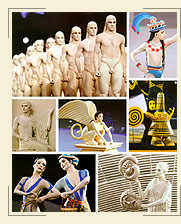 event
of the 28th Olympic Games. Full of symbolism and allegory,
it brought together the past, present, future and Hellenic
culture and related them to the Olympic ideal and the universal
virtues of love for man, for art and hope for the future.
The result proved worthy of expectations, since everybody
agreed that it was once of the most successful opening ceremonies. event
of the 28th Olympic Games. Full of symbolism and allegory,
it brought together the past, present, future and Hellenic
culture and related them to the Olympic ideal and the universal
virtues of love for man, for art and hope for the future.
The result proved worthy of expectations, since everybody
agreed that it was once of the most successful opening ceremonies.
The countdown started from 28 -the number of Olympiads since
1896- and, when it was over, virtual fires engulfed the two
screens and then the Kalatrava roof. Then followed the symbolic
connection of the modern and the ancient Olympic Games, since
before the five cycles were lighted, the spectators watched
a virtual journey to the Stadium of Ancient Olympia.
The Greek flag was brought into the stadium by a child on
a paper boat, reminding how the image of the Greek spirit
was shaped during the 1930s. Then, followed the part of the
ceremony that Dimitris Papaioannou, the man who had created
it, had called "Allegory", which is essence was
a hymn to the greatness of man.
The Aegean with its islands was the reason for the following
unit, during which, after a hymn to Love, as the motivating
force of humanity, the hourglass gave a 12-minute tour of
history to the spectators. Masterpieces of art and culture
from the Minoan period to the 20th century paraded in front
of the spectators.
A pregnant woman and Love were the leading characters of the
next unit of the ceremony, a direct reference to the hope
for the future of humanity. Immediately afterwards a rock
was formed and an olive tree grew on top of it, one of the
strongest symbols of the Olympic Games from Antiquity to the
present day. It was time for the performers to leave and the
athletes to parade. |