|

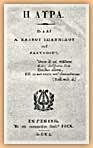
The period that began with the Revolution of 1821 inevitably placed the literary events of Hellenism in a new framework. The intellectual products of modern Greek Enlightenment, the disputes between the modernists and the conservatives and the question of which language literature should use, continued to preoccupy the intelligentsia. In addition, the events of the Struggle motivated consciences and provoked the feelings of new intellectuals from the now British-ruled Ionian Islands - an intellectual trend which resulted in the bringing together of many different elements from the various cultures across those Islands. The tradition of the Cretan renaissance of the 17th century and of Erotokritos, as it was transferred to the Ionian Islands by Cretan migrants after the Ottoman occupation of Crete, the effects of the European Enlightenment which reached the Ionian Islands under the regime of Venetian rule, the political developments following the French Revolution, particularly the Italian versions of liberalism and the movement of the Carbonari and, of course, the first effects of romantic poetry, formed the backdrop for a new generation of poets at the beginning of the 19th century. The poets of the Heptanesian School wrote in colloquial language, and opposed the archaizing and expurgated language which prevailed in Athens. They created their linguistic model using elements both from the literate tradition and from the popular spoken language, while their themes were drawn not only from the national struggles but also from scenes and problems of everyday life and personal relations. Andreas Kalvos from Zakynthos (1792-1869) issued his ten first odes entitled I lyra (The Lyre) at Geneva in 1824, while two years later ten more odes entitled Lyrika (Lyrics) were published. In the same period, Dionysios Solomos began writing in Greek. Solomos is one of the most important representatives of the Heptanesian School and not only his poetry and criticism but also his linguistic choices influenced the course of the intellectual life of Hellenism. Around him there formed a circle of scholars who shared his poetic and linguistic opinions. They were Ioulios Typaldos, Georgios Romas, Spyros Melissinos and others. In 1859 one of them, the writer and translator Iakovos Polylas (1825-1896), issued the Evriskomena of Solomos with an extensive preface, the Prolegomena. Corfu became a centre of cultural and spiritual activity in direct contrast to the aspirations of the First Athenian School which developed in the same period. Gerasimos Markoras (1826-1911) and Aristotelis Valaoritis (1824-1879) came to prominence around the same time. They cultivated a narrative poetic writing with characteristics more epic than lyrical. In 1875 Markoras wrote the Orkos (Oath) inspired by the Cretan revolution of the 1860s. Valaoritis participated in the movement for the union of the Ionian Islands with Greece and was elected deputy of Lefkas immediately after that union came about. He was the principal poet to draw his themes from the klepht-armatolism tradition. Employing such elements and participating in the myth-making of the image of the klephts in the Ottoman period, he wrote poems such as Kyra Phrosini (1859), Athanasis Diakos and Astrapogiannos (1867). His most important - albeit unfinished - composition is Photeinos published after his death in 1891.
|
 |