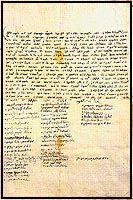
 Letter from the fur-guilders of Constantinople, 1782 |
The structure of the guild changed little during the Ottoman period. It was made up of craftsmen (usta), assistants (kalfa) and the cirak or apprentice. The guild was organized as a hierarchy and each position had strictly determined obligations and rights. At first the apprentice worked closely with a craftsman to learn his skill. Usually he worked for free or earned a minimum wage. The cirak and the kalfa depended on the craftsman for their promotion. The craftsman, on the other hand, was duty-bound to train his trainees, teach them the secrets of his art and introduce them to the traditions of the guild.
guild:
common variations: esnaf, rufet
 Silver-plated mitre, produced by the guild of chrisikon from Ioannina, 1636 |
The length of apprenticeship varied but was usually long. This was not so much to allow the apprentice to learn his craft but in order that he should fulfil his work as a servant in the workshop and the home of the craftsman, and in order for him to become thoroughly familiar with the strict hierarchy of the guild. Promotion from kalfa to usta did not follow a strictly professional procedure. For example, a perfectly normal way to become an usta was to marry the widow of a ex-usta. One should not forget the social role of the guild at this juncture. Each guild had a support fund in case of emergency, which meant that in the case of illness or unavoidable cessation of work, the guild cared for the needs of the suffering member. In the event of death, the guild looked after the family of the deceased and quite often paid the funeral expenses if the family could not afford them.