the width of word, prudence,
 simplicity, pain,
they mourn, they lament.
For not in life do they Leo see...'
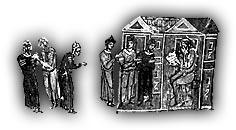
Leo the Philosopher, also known as Leo the Mathematician, was born in Thessaly circa 790. He was very well educated and travelled through the provinces, and especially Andros, within whose monasteries he found rare manuscripts. While still relatively unknown, he became a private teacher in Constantinople. During the Byzantine-Arab wars, one of his students was captured and taken to the Arabic capital. The Caliph al-Mamun was amazed by his mathematical knowledge. On learning the name of his teacher, the Caliph sent a delegation to Byzantium and invited Leo to join him, offering him a wealthy life. The Byzantine Emperor Theophilos, learning of the caliph's offer, asked Leo to stay in Byzantium and made a counter-offer, a tutorship position in the capital. In the period 840-843, Leo was Metropolite of Thessalonike. Afterwards he returned to Constantinople where he was appointed to teach philosophy in the newly founded School of Magnaura, where he served until his death, sometime after 869. He was a great mathematician, astrologer and philosopher. It is believed that it was he who invented the lighting machinery that warned Constantinople of Arabic raids from Tarsos, Cilicia. He also created automata and wrote philosophical, philological and literary works (epigrams), not all of which have survived, however.