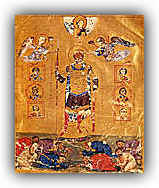
 most important figures of his era.
 Romanos II΄s son, he ascended to the throne on the death of John Tzimiskes, at the age of eighteen. In the first years of his reign, the Empire was virtually governed by the illegitimate son of Romanos Lekapenos, proedros Basil. The epitomy of the aristocracy of the capital, the proedros Basil regulated political matters, a fact which led to the violent reaction of the major aristocratic families of Asia Minor and the revolts of Bardas Skleros and Bardas Phokas.
These movements created a state of virtual civil war and, in combination with external threats, brought difficult times for the new Emperor. With Phokas΄ death, Skleros΄s subjection and Basil΄s banishment, Basil II became the sole and undisputed leader of the Empire.
Important victories were won on all fronts throughout his reign: victories against the Bulgar leader Samuel, expansion of the borders up to the regions of Iberia and Georgia, conclusion of a truce with Egypt's caliph and the great success of the Byzantine administrators of Southern Italy in repelling the assaults of the Normans, Arabs and Germans. At the same time, in domestic policy, measures strongly opposed to the interests of the aristocracy was pursued.
The preferential treatment of top-ranking officials in judicial matters was abolished, whereas any purchase of land belonging to a 'village community' by the dynatoi (powerful) landowners undertaken since 928 was annulled. The fiscal step of allelengyon (996), namely the communal collective tax responsibility according to which the dynatoi were obliged to pay the taxes of the economically weak adynatoi, displayed clearly the aim of Basil to support the adynatoi as well as to reduce the excessive power of the dynatoi.
Finally, in his effort to reduce the power of the Themes, generals, or the local administrators of the Themes, were placed in a series of garrisons in sensitive positions and important cities, which came directly under the Emperor's rule.