The monastery of Hosios Loukas in Phokis comprises two churches: the
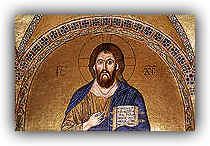 original church of Panagia (Virgin Mary) and the katholikon of the monastery consecrated to Hosios and constructed in order to enclose and preserve his grave. The monastery comprises also other elements such as the refectory, cells for the monks etc. The katholikon was built on a cross-like crypt. According to one view, this crypt was the first holy place built by Hosios's disciples after his death. In 1011 his relics were removed to the newly-built katholikon by the abbot of the monastery, Philotheos, who is believed to be the person represented in the church and the crypt. From the sources we have, it has been concluded that an important role in the decoration of the katholikon was played by the local aristocracy and particularly by Theodoros Leovachos, scion of an eminent family in Thebes, who was abbot of the monastery shortly before the middle of the 11th century. The biggest part of the katholikon is decorated with mosaics consisting of a large number of hagiologic portraits and a few other depictions. In the naos five scenes taken from the public life of the Christ are depicted and in the narthex four scenes from his Passion and Resurrection. From a stylistic point of view, the mosaics are characterized by an intense linearity and schematization that give them a monastic austerity. Their intensely anti-classical character links them with the mosaics of St Sophia in Kiev (1042-6) and the mosaics of the Panagia Chalkeon (Virgin of the bronze-smiths) in Thessalonike (1028), allowing us to date them to the decade 1040-50. The three chapels surrounding the central part of the katholikon are decorated with wall paintings related stylistically to the mosaics of the church and date from the middle to the third quarter of the 11th century. The northeastern chapel includes the grave of Hosios Loukas and constitutes the holiest part of the site. Finally, wall paintings decorate the crypt as well, which has many characteristics in common with the mosaics of the narthex and are dated also from the middle of the century.