The battle of Mantzikert is considered as an event of great importance for
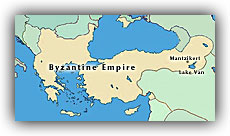 Byzantium. It marks the beginning of the collapse of the Byzantine state and for many researchers constitutes the conventional dividing line between the Middle and the Late Byzantine Era.
It is the last large-scale military operation of Romanos IV Diogenes. His march up to Mantzikert was marked by a series of incidents which were interpreted as unfavorable omens for the outcome of the expedition. On the 26th of August 1071 the emperor, rejecting a peace treaty on behalf of the sultan Alp Arslan, took the decision to confront the Turks. After a short victory, Romanos decided to return to the camp. Andronikos Doukas, however, spread the false news that the emperor has been defeated and retired his men. Various rumours rapidly spread. The Turks noticed the upheaval and took advantage of it. They attacked, and as a result Romanos was captured and the Byzantine army defeated.
The defeat at Mantzikert meant the collapse of the administrative system in the eastern provinces. The following decade (1071-1081) was marked by a series of internal disputes among the Byzantines, who asked even for the help of the Turks. Characteristic and evident of the extent the Turkish flood had assumed, is the fact that the future emperor Alexios, returning via Amaseia to Constantinople in 1074, travelled by boat, for all land routes were controlled by the Turks.
The defeat at Manjikert was not an event that caused sensation. It was the result of the domestic and foreign developments that had lasted more than half a century after the death of Basil II. Asia Minor did not fall apart directly after 1071. The battle of Mantzikert, however, meant the beginning of the end, the start for the occupation of one of the most important and wealthy parts of the empire, of Asia Minor, and the foundation of a powerful state by the Seljuk Turks.