|
|
|
 |
|
The artistic representation of holy figures on wooden boards can be traced back to the portraits of Greco-Roman antiquity.
 These
were mostly portraits of deceased persons. Such were the portraits known as the
Fayyum portraits, from the Middle Egypt area where they were found. They date from the 2nd
to the 4th centuries.
The worship of the dead was a prominent feature of later Roman religious
practice; and a trend adopted by the early Christians in their burial devotions
for the martyrs of the new religion. It can therefore be assumed that very early
on Christians worshiped the portraits of their own important dead, the martyrs and apostles, in accordance with their devotional practices. Contemporary
sources inform us of the existence of icons of Christ, the Virgin Mary, the archangel
Michael and other saints later on in the 4th and 5th
centuries.
 Among
the few surviving Early Byzantine icons the most remarkable
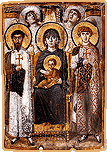
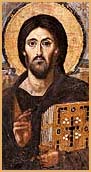
are those found in the monastery of St. Catherine on Mount Sinai. Namely,
these are an icon of the enthroned Virgin holding the Holy Child and flanked by two military
saints and angels; an icon of Peter the Apostle; and one of Christ Pantokrator (omnipotent).
All three icons are examples of the encaustic technique, which consists of
colours mixed with molten wax and then spread on the surface of the painting
while the mixture was still hot. A preparatory linear drawing was
not required in this technique and colour lent volume and natural substance to images.
These elements are evident in the three icons mentioned above. Soft hues, the
depiction of faces and the architectural depth created by perspective bring
these masterpieces very close to the Hellenistic tradition. Dating back to the 6th
century, the Sinai icons probably came from a Constantinople workshop.
|
|
|


