The one Greek power which managed to maintain its independence, at least until 168 BC, was Rhodes. The island's wealth came from its developed trade. Its geographical position, in combination with its natural harbours, made it a transactions centre. Rhodes was situated on the crossroads of the Mediterranean sea routes, from Egypt, Cyprus and Phoenicia to the Aegean, the Black Sea, Italy and North Africa. Therefore it was in the advantageous position to negotiate the grain trade and intervene between producers and the markets that would sell the goods. The Rhodian merchant navy was the biggest in the Hellenistic world and, from the 4th century BC, it dominated the wine, olive oil and grain trade. The ships of the Rhodian fleet were renowned, whilst the skill of Rhodian engineers was successfully tested during the siege by Demetrius Poliorcetes.
Even though the island was under the rule of a marine aristocracy and its regime was not democratic, Rhodes was an exception in a political environment represented chiefly by kingdoms. The island's aristocracy governed with a style based, for the most part, on a system of maritime laws, famous at that time. According to certain scholars, the island had managed to maintain certain elements from the time of the domination of the Greek cities, such as pride and certain constitutional structures. In contrast to the other cities of the Hellenistic kingdoms, which were based upon the use of mercenary troops, Rhodes was in a position to use a large number of citizens to man its fleet.
In 306 BC, it had concluded a treaty with Rome. It did not submit to the claims of Demetrius Poliorcetes and successfully confronted his siege in 305-304 BC. Rhodes maintained good relations with the Ptolemies, because it depended on them for grain imports from Egypt. In 182-179 BC, it fought against Eumenes II of Pergamum, because he tried to block the trade route through which Rhodes transported grain towards the Black Sea. Lastly, Rhodes used its fleet to try and relieve the Aegean from the scourge of pirates.
The life of the inhabitants was based on trade and banking transactions. Apart from wine production -probably the only product that was being exported- agriculture played a secondary role in the island's economy. It is known that, at the beginning of the 2nd century BC, Rhodes' revenues from customs duties, to the extent of 2%, amounted to one million drachmae annually. And of course, both trade and bank activities brought in much bigger profits.
The role of Rhodes as a trade station which controlled the grain market and furthered various transactions, was very significant for the kingdoms. The magnitude of this significance can be perceived by their reactions, when the city was destroyed - which is when the famous Colossus collapsed-, during an earthquake in 228/7 BC. Hieron II of Syracuse, the Ptolemies and the Seleucids offered substantial assistance in the reconstruction of Rhodes. It is worth mentioning the 75 talents for the new Gymnasium, the exemption in the kingdoms' customs, the 35,000 tons of grain, the 3000 talents for the reconstruction of the Colossus, the 100 contractors and 350 workers including their salaries, 3000 talents worth of iron and 1000 talents worth of materials for reconstruction.
The period of prosperity for Rhodes ended in 167 BC, when the Romans, reacting to the ambiguous position of the Rhodians during the 3rd Macedonian war, appointed the rival harbour of Delos as free and duty-free. Soon the Rhodians saw their profits decreasing and they complained saying characteristically that their income had reduced to 150,000 drachmae annually.
| introduction |
kingdoms |
cities |
factors |
Note: Click on the small photo to enlarge it.
|
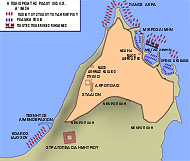
01. Map showing the siege of Rhodes by Demetrius Poliorcetes, in
305 BC. 
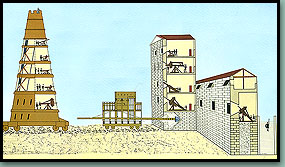
02. Drawing of a battering ram, which was used in the siege of Rhodes by Demetrius Poliorcetes, and part of the island's fortification.
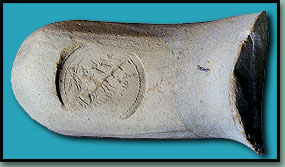
03. The handles of Rhodian amphorae, which have been found around the Mediterranean, reveal the island's trade relations with different regions in that area. Photo: sealed handle of a Rhodian amphora with a representation of Helios on his quadriga.
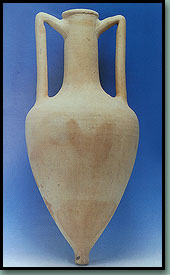
04. Rhodian point-based amphora. End of the 3rd century BC.
|
