 |
 Apart
from the Twelve Gods, a number of minor gods, with several differences
between them depending on the place of worship, existed. Hestia, once included
in the Twelve Gods, was the goddess of the hearth and the city. Eileithyia
was the goddess of childbirth and her name is considered to derive from the verb form
eleuthyia (the one who is coming). She was related sometimes with Hera and sometimes with
Artemis and her sanctuaries were situated outside the boundaries of the city.
Another pre-Homeric god was Enyalius, god of war, who is identified with
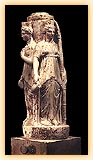
Ares in the Iliad. Hecate was a separate deity -at least until the Classical era-
when she began to be identified with Artemis more often. She was the goddess of the
moon, of nocturnal rituals, of magic but also of the streets, for this reason she
was also called Enodia. Her origin was Carian and her most important sanctuary was
at Lagina in Caria. Apart
from the Twelve Gods, a number of minor gods, with several differences
between them depending on the place of worship, existed. Hestia, once included
in the Twelve Gods, was the goddess of the hearth and the city. Eileithyia
was the goddess of childbirth and her name is considered to derive from the verb form
eleuthyia (the one who is coming). She was related sometimes with Hera and sometimes with
Artemis and her sanctuaries were situated outside the boundaries of the city.
Another pre-Homeric god was Enyalius, god of war, who is identified with
Ares in the Iliad. Hecate was a separate deity -at least until the Classical era-
when she began to be identified with Artemis more often. She was the goddess of the
moon, of nocturnal rituals, of magic but also of the streets, for this reason she
was also called Enodia. Her origin was Carian and her most important sanctuary was
at Lagina in Caria.
|
| Among the large family of gods, demi-gods and heroes it is worth mentioning
certain deities whose cult had a clearly local character. The Titan, Prometheus,
for instance, was worshiped mostly in Athens, often in connection with Hephaestus,
as they were both using fire. However, whereas Hephaestus was a bronzesmith, Prometheus was a potter.
Leto, the mother of Artemis and Apollo, was worshiped mostly in Crete and Lycia.
Belonging to the sea deities was Thetis, who was worshipped in Pharsalos and Sepias in Thessaly, and also
in Sparta. Her son, Achilles, was worshipped as Pontarches, that is lord of the Black Sea.
Another sea deity was Leucothea, who was worshipped in Phigaleia under the name
Eurynome. Lastly, an old man of the sea appeared in various places under different names:
Proteus, Phorcys, Nereus, Glaucos. |
 Between
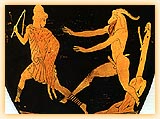
man and animal stood Pan depicted as a goated, often ithyphallic
god. He was indeed the god of the boundaries between civilized world and wild nature.
His cult was important in Arcadia, whereas in Attica he appeared as late as the 5th century BC.
There were numerous group deities such as the nymphs of the springs and the forests
accompanying Artemis, the Nereids controlled by Thetis, as well as the Satyrs, the Selinoi and the Maenads
who belonged to the Dionysian thiasos. Among other group deities the Charites (Graces), Moirae (Fates),
Muses, Eumenides (Kind ones) or Erinyes (Furies), Horae (Hours), Corybantes, Telchines and
Cabiri are worth mentioning. Between
man and animal stood Pan depicted as a goated, often ithyphallic
god. He was indeed the god of the boundaries between civilized world and wild nature.
His cult was important in Arcadia, whereas in Attica he appeared as late as the 5th century BC.
There were numerous group deities such as the nymphs of the springs and the forests
accompanying Artemis, the Nereids controlled by Thetis, as well as the Satyrs, the Selinoi and the Maenads
who belonged to the Dionysian thiasos. Among other group deities the Charites (Graces), Moirae (Fates),
Muses, Eumenides (Kind ones) or Erinyes (Furies), Horae (Hours), Corybantes, Telchines and
Cabiri are worth mentioning. |