 |
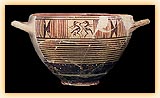 Corinth
The pottery production of Corinth, indeed of the whole of the Peloponnese, during the
11th and the 10th centuries BC, was closely indebted to Attic models.
From 900 BC approximately, the pottery of Corinth began shaping individual
vase types. The Attic tradition of covering part of the surface with black glaze was adopted,
but at the same time a decoration developed of narrow, parallel lines made with the help of the wheel.
Pictorial representations were few and were limited mostly to
schematic birds. Vases of this period, a particular class of skyphos for example, are among
the first Greek vases to have reached the West (Sicily and southern Italy).
The popular shapes of Corinthian Geometric pottery include the kotyle,
the oinochoe with conical body and high neck, and the pyxis with rounded body and domed lid.
All these vases spread to a large part of the Mediterranean thanks to the
commercial and colonial activities of Corinth. Towards the end of the 8th century BC,
and while the Late Geometric style was still in vogue in Athens, Corinthian potters
adopted a new style with intense orientalizing elements, the so-called
Protocorinthian style. Corinth
The pottery production of Corinth, indeed of the whole of the Peloponnese, during the
11th and the 10th centuries BC, was closely indebted to Attic models.
From 900 BC approximately, the pottery of Corinth began shaping individual
vase types. The Attic tradition of covering part of the surface with black glaze was adopted,
but at the same time a decoration developed of narrow, parallel lines made with the help of the wheel.
Pictorial representations were few and were limited mostly to
schematic birds. Vases of this period, a particular class of skyphos for example, are among
the first Greek vases to have reached the West (Sicily and southern Italy).
The popular shapes of Corinthian Geometric pottery include the kotyle,
the oinochoe with conical body and high neck, and the pyxis with rounded body and domed lid.
All these vases spread to a large part of the Mediterranean thanks to the
commercial and colonial activities of Corinth. Towards the end of the 8th century BC,
and while the Late Geometric style was still in vogue in Athens, Corinthian potters
adopted a new style with intense orientalizing elements, the so-called
Protocorinthian style. |
| Thapsos group This group (which belongs to the second half of the 8th century BC)
is often linked to Corinth, as it includes the same vase shapes and appears to have used the
same kind of clay for manufacture. It owes its name to Thapsos in Sicily,
where its first specimens were found. With regard to decoration, this differs from Corinthian pottery,
owing to its unusual motifs and more frequent pictorial representations. It is unknown in
Corinth but spread through the northern Peloponnese, central Greece and Sicily. It was probably
manufactured in Megara as, according to Thucydides, the colonists from Megara had
settled for a short time in Thapsos before migrating to found
Megara Hyblaea in 728 BC. |
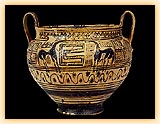 Argos
The early and middle Geometric pottery of the Argolid followed closely upon the
achievements of Attica and Corinth, imitating on the one hand the large black-glazed surfaces and, on the
other, the narrow bands. During the Late Geometric phase, however, the motifs
became differentiated and rows of massed zig-zags, lozenges and spirals prevailed. Among pictorial
representations the most common was a man leading a horse. The most characteristic vase shape
was the pithos with lid and three small banded feet. This type recalls Cycladic and Cretan vases
of the same period, thereby revealing the areas with which the Argolid was in close communication. Argos
The early and middle Geometric pottery of the Argolid followed closely upon the
achievements of Attica and Corinth, imitating on the one hand the large black-glazed surfaces and, on the
other, the narrow bands. During the Late Geometric phase, however, the motifs
became differentiated and rows of massed zig-zags, lozenges and spirals prevailed. Among pictorial
representations the most common was a man leading a horse. The most characteristic vase shape
was the pithos with lid and three small banded feet. This type recalls Cycladic and Cretan vases
of the same period, thereby revealing the areas with which the Argolid was in close communication. |