 |
||
The Mycenaean wall-painting art comes from Minoan Crete where it had appeared already from 1700 BC in rooms of the palaces and in other luxurious buildings of Crete. The first Mycenaean frescoes date to the 15th century and coincide roughly with the second building phase of the Minoan palaces. It is very likely that this art had reached mainland Greece earlier since the most intense Minoan influences occurred during the early phases of the Mycenaean period. Certain archaeological indications, such as the coloured plasters of buildings of the Middle Helladic period and some fresco fragments from the citadel of Mycenae which were found with ceramics of the Late Helladic I and II periods verify this suggestion. Most examples of Mycenaean frescoes date to the 14th and 13th centuries BC and are related to the palatial apartments of Mycenae, Tiryns and Pylos or with seats of local chiefs, as Gla, Argos and the Menelaion. The fresco decoration constituted an incontestable demonstration of prestige but its existence in private buildings shows that they were not an exclusive privilege of the chiefs. Apart from their presence in the official architecture, frescoes have been discovered in graves of eminent persons and in sacred buildings. As the Minoan frescoes, the Mycenaean ones, were drawing compositions on plaster which were made with the fresco technique. The drawing should be completed before the plaster dries. That is the reason for which it required great ability and a whole staff of craftsmen which worked at the same time for the drawing of large iconographic compositions. The paints that were employed had an earthen texture and their colours were blue, red, yellow and black. As the painted tombstones, various limestone plastered tiles and clay larnakes show, the same technique was applied on mobile objects. The themes of the Mycenaean frescoes can be distinguished in three different categories: iconographic representations from the religious life of the population, representations of the favourite occupations of the ruling class and abstract decorative themes. The latter functioned as a frame of the illustrations and as decorative covers on floors, ceilings and elsewhere. The decoration procedure of the frescoes was organized in three levels. The main drawing representation was placed in the middle of an outlined jamb which was painted to resemble veined marble and in a decorative band. In addition, the representation of building elements, mainly wooden beams, was common. The so-called miniature style which is expressed on long friezes which depict representations with figures of a very small size, has a distinguished Mycenaean character. As far as the iconographic representations are concerned, the Cretan influence in the style and selection of the themes is manifest. As the Minoan frescoes, the Mycenaean as well include bull-leaping, evil creatures and architectural elements. The purely Mycenaean subject matters were the hunting and battle scenes and the processions of women in costumes offering gifts. The themes of the frescoes reveal the religious and heroic sprit of the Mycenaean aristocracy. The battle scenes are of a narrative character and depict probably specific moments or historic events. The themes and fresco styles seem to have influenced the other iconographic arts of the Mycenaean period. Thus, similar classification of the iconographic themes occurs in ivory carving, pottery and seal carving. The frescoes of the 13th century BC, no longer based on the Minoan models, acquired an established Mycenaean character which presents strong schematization, rigidity and inartistic creation. The destruction of the palaces around 1200 BC marked the end of the mural painting which was connected with the official architecture. The only memory of the old art are some improvised paintings in the shrine of the Lower Citadel of Tiryns. |
 |
|
|
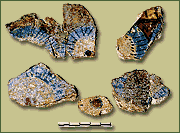
Gla, room H4. Fresco
fragments with
rosette representation. |
||
 |
||
|
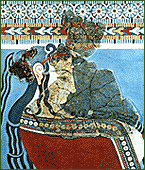
Tiryns. Fresco with female figure
from the later palace. |
||
 |
||
|
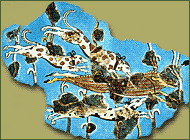
Tiryns. Frecso with a
boar hunting scene
from the later palace. |
||