 |
||
The term metallurgy includes the extraction of metals and all the stages of processing (forging, melting) until their formation (metalworking) into serviceable objects such as jewellery, tools and weapons. The melting of metals in clay crucibles, with a controllable intensifying of the fire by clay nozzles, and their formation into stone or clay moulds is known from the Early Neolithic II (4800-4500 BC) and the Final Neolithic (4500-320 BC). The manufacture of brass (bronze) from copper and tin, for durable tools takes place in the Aegean during the Early Bronze Age and brings about the increase of agricultural production and the development of artisanship. The metal finds and the tools for their manufacture which were discovered in settlements of mainland Greece verify the local practice of metalworking. Metalworking workshops were identified in closed and open areas in Raphina and Koropi of Attica and in Tiryns whereas in Aegina IV (2300-220 BC) a built copper-smelting works was found. It is possible that some of these were production centres (Raphina, Aegina) which supplied other settlements with metal tools. According to archaeometallurgical research, the raw materials (copper, lead, silver) of the EH settlements in the beginning of the 3rd millenium BC come from mines of Siphnos (Agios Sostis) and probably from Syros and Seriphos). From the middle of this millenium systematic extraction of lead and silver takes place in the mines of Laurion and Thorikos of Attica. Tin, a basic metal for the production of bronze does not exist in the Aegean. Thus it reached the mainland not as an identical metal but in the form of a bronze alloy, via the Aegean islands from Uzbekistan, Afghanistan or Asia Minor (Tauros mountain range). Furthermore, the use of tin from the Balkans and central Europe which reached the Greek mainland about the end of the Early Helladic II period via the west Adriatic and the Ionian sea is also likely. The finding of metals was a concern of the metalworkers, which were involved in trade, nd thus acquired wealth (prestige goods) and a distinguished social identity. The metalworking of the Greek mainland does not seem that advanced as in the northeastern Aegean and the Cyclades. Metal products include implements, weapons, jewellery and sparsely vases. The earliest bronze finds derive from Lerna of the Argolid, Agios Dimitrios of Triphyllia and Lithares of Boeotia: implements (blades, chisels, knives, hooks) and jewellery (pins). The copper tools ("treasures") of the EH II period which were hidden in Thebes (6), in Eutresis of Boeotia (4) and Petralona of Chalkis (42) constitute distinguished examples of the Helladic metalworking.
|
 |
|
|
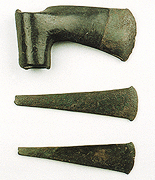
Petralona in Chalkidike.
Axe and chisels
from the treasure of bronze tools. |
||
 |
||
|
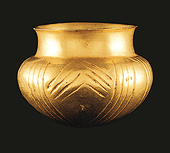
Hammered gold bowl with
incised linear
decoration from the Treasure of Euboea. |
||