 |
||
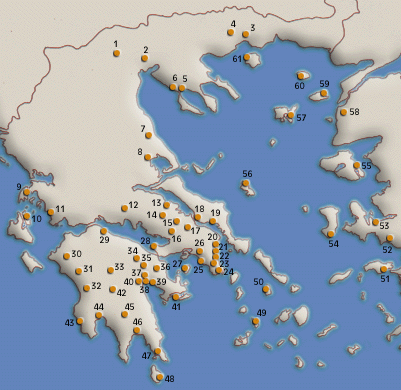
The increase of population which occurs during the Early Bronze Age, particularly in south Greece results in the raise of the number of settlements compared to the Chalcolithic Age (4500-3200 BC). The settlements are built on high hills (30 metres) or low ones which are usually close to the coast. The fertile plains as well, whether they are coastal or in the inland, favour the development of populous settlements (e.g. Manika, Lithares). Most of the known settlements occupy 1 to 3 hectares (1 hectare = 10.000 square metres) while very few of them exceed 8 hectares (Manika-45, Thebes-20). Settlement architecture varies and some urban planning systems are identifiable. Many sites have dense building structure in clumps which are separated by roads and narrow paths (irregular or extensional, e.g. Zygouries, Askitario). The sites whose main building unit consists of buildings with curvilinear walls (Orchomenos, Lerna IV) have an irregular arrangement. More rarely, the buildings flank a central road which runs through the whole settlement (linear, Lithares). Finally, the radiating arrangement of building blocks composed of identical buildings separated by parallel streets (around a common centre, Aegina V) is unique. Many EH settlements have preserved parts of defensive-fortification walls of a simple or complex form. The buildings in south Greece are made of stone foundations and walls of unbaked mudbricks. They are rectangular, trapezoid, circular or apsidal and usually have only one ground floor. The total surface varies from 30 to 50 square metres. |
 |
|
|
The most important Early Bronze Age sites known on the Greek Mainland. |
||
|
Their interior includes hearths and kilns for cooking and stone benches for sleeping, food preparation or the deposit of goods. Products were stored in pithoi or amphoras, containers made of wood, hides or reeds but also in storage pits ("bothroi") which are dug into the ground. Special buildings, as the rectangular"Corridor Houses" (300 square metres) and the "Rundbau" of Tiryns are significant examples of the EH II architecture. Researchers associate these buildings with the ecomonic and social changes of the EH II period and interpret them as political-administrative and economic centres of the EH communities. specialization The elements that lead to the identification of early urban centres in many of the EH II and III settlements are: the area and town planning of many settlements, the arrangement of stone paved roads and squares for public use, the existence of fortification systems and buildings with special functions, the specialization of production and the function of workshops, the practice of trade, etc.. The Early Bronze Age settlements in Macedonia and Thrace are composed of rectangular and apsidal, timber-post framed houses (Mandalo, Sitagroi, Dikili Tash) and more rarely stone built ones (Kastanas, Agios Mamas, Toumpa of Thessaloniki) and do not show an urban character. |