 |
||
In the beginning of the Late Bronze Age the Aegean islands had become very important for the economy because of the distribution of goods to the ports and the foundation of Minoan and Mycenaean trade centres. As a result the islands attracted new populations which settled in previous sites or founded new settlements. As in the previous period, the locations preferred were the few and narrow plains and mainly the safe ports which facilitated marine communication. Akrotiri on Thera, an extensive settlement which was destroyed by the eruption of the volcano of Thera during the Late Cycladic IA period provides the most complete picture of life in an early Late Bronze Age settlement in the Cyclades. The building remains of this period which are revealed out of layers of volcanic tephra are preserved in such a good state that they give us a unique picture of the life in the settlement. Theran architecture can be considered as Minoan because Minoan elements are attested in Akrotiri, for example the carved stone masonry, the wooden framework, the polythyra and the lustral basins. On Thera -in Balos, Ftellos- and on Thirasia small independent farmsteads have also been found. The best known and best preserved urban centres of the Cyclades during the mature periods of the Late Cycladic period are two settlements that had been founded in the Middle Bronze Age: the settlement of Agia Irini on Keos and the settlement of Phylakopi on Melos. These settlements present a single and perfectly organized settlement plan and have an underground sewage system. In addition, significant elements on the settlement architecture of the Late Bronze Age derive from the settlements of Delos and Grotta on Naxos. Thera was reoccupied in this period in the position Monolithos. The Cycladic settlements of this period have many Mycenaean elements which is apparent also from the foundation of Mycenaean sanctuaries at Agia Irini and Phylakopi. The Mycenaean presence in the northeastern Aegean is indicated by the sporadic finds of ceramics, figurines and from few building remains. From the beginning of the 13th century BC, the evolution of the insular settlements is common with that of mainland Greece. The fortification works of the settlements were strengthened obviously because of the same feeling of insecurity. As indicated by the settlements of Koukounaries on Paros and Agios Andreas on Siphnos the new settlements were founded on naturally fortified and inapproachable sites. Around 1200 BC a chain of destructions which is contemporary with the destruction of the Mycenaean citadels occurs in the insular settlements. About the beginning of the 11th century BC certain settlements (Phylakopi, Koukounaries) are abandoned while other ones experience decline. The settlement evolution in this period from the Submycenaean to Protogeometric times is rather dark but there are stratigraphic indications from the settlement of Grotta that show that habitation was not interrupted. |
 |
|
|
The most important sites of the Late Bronze Age
on the Aegean islands. |
||
 |
||
|
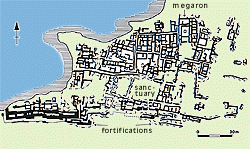
Melos, Phylakopi.
Plan of the Late Cycladic town III. |
||