| Crete is part of the Hellenides mountain range created by the
same tectonism that was responsible for the orogenesis of the Alps and the
formation of the Mediterranean Sea during the first half of the Quaternary period
about 40-20 million years ago. The land is constituted of three
tectonic plates whose borders are located in
the isthmus of Ierapetra and Rethymnon.
The tectonic trenches were filled periodically by sea deposits which were transformed
into limestone rocks and limestone and clay soil. |
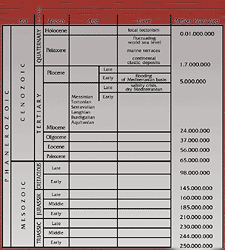 During
the Mediterranean salinity crisis which started in the late Miocene and
lasted two million years, successive deposits of evaporated minerals accumulated
in the Mediterranean basin. The deposits of this period on Crete resulted
in the formation of extensive plains, such as the Mesara plain which is
rich in limestone sediment. The residues of this period appear in plants
and sea microfossils which are found in the clay used in Minoan ceramics.
These rocks also contain pieces of crystalline gypsum - or gypsum - a material
often used by the Minoans in the construction
of buildings, mainly in central Crete. During
the Mediterranean salinity crisis which started in the late Miocene and
lasted two million years, successive deposits of evaporated minerals accumulated
in the Mediterranean basin. The deposits of this period on Crete resulted
in the formation of extensive plains, such as the Mesara plain which is
rich in limestone sediment. The residues of this period appear in plants
and sea microfossils which are found in the clay used in Minoan ceramics.
These rocks also contain pieces of crystalline gypsum - or gypsum - a material
often used by the Minoans in the construction
of buildings, mainly in central Crete. |
| Towards the end of the Messinian age and at the beginning of the Pliocene epoch, that is
5 million years ago, the entire Mediterranean basin was flooded with Atlantic water.
Towards the end of this geologic period regional tectonism gave rise to an island approximately
equivalent to Crete.
The heights of Psiloritis were elevated enough to experience a cold climate
and the so-called stonemounts were created. The deposits of the late Pliocene are more or less
uniform throughout the island, constituting one third of its surface.
There is an obvious correlation between the Neogene rocks and the areas that
were chosen for habitation, for these rocks were appropriate for stone quarrying
and their soil is also of good quality. Important centres of
Minoan civilization, such as Phaistos and Agia Triada are situated on a Plio-Pleistocene
tectonic horst fault block. |