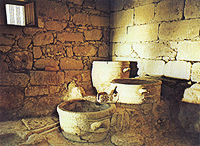
 The Bronze Age Cretan economy was pre-monetary,
that is it was a barter economy, and did not depend on the use of money.
Until the end of the Minoan period the main resources were agriculture
and cattle breeding, and trade in handicrafts.
Some of the first exchangeable goods of the Early Minoan period were metals
(notably obsidian) and more rarely, artworks. That there were organized commercial transactions
during this period is indicated by the widespread use
of seals, which have been found mainly in tombs. The Bronze Age Cretan economy was pre-monetary,
that is it was a barter economy, and did not depend on the use of money.
Until the end of the Minoan period the main resources were agriculture
and cattle breeding, and trade in handicrafts.
Some of the first exchangeable goods of the Early Minoan period were metals
(notably obsidian) and more rarely, artworks. That there were organized commercial transactions
during this period is indicated by the widespread use
of seals, which have been found mainly in tombs. |
|
| The administrative system of the palatial period led to
a new form of centralized economy in which goods were collected
and traded exclusively by the palace centres.
The goods traded at the palaces were mainly agricultural and dairy produce.
Tools and the fine pieces of Minoan art also played an important role.
As is seen from the texts of the palace archives, handicrafts made of
perishable materials such as certain fabric and wooden articles, had a great commercial value.
The copper ingots found at some sites may have been used as exchangeable goods, but they probably never
served a purely monetary purpose, as initially suggested. A secure bureaucratic system was
developed for the control of trade: the goods and produce were sealed and stored in special places
until the time of their transfer to their designated destination. The systematic and large scale storage of
goods created the need for archives, which led to the development and systematic use of
a writing system.
|
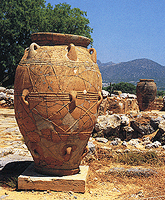 The need for raw materials for the palace artisans was a
decisive reason for trading on an international scale and
consequently for stepping up transportation and shipping.
External trade consisted of the exchange of Cretan goods with rare raw materials and
luxury products from foreign countries. It is likely that Cretan seamen
had undertaken the transit trade as part of an international trade network.
The importation of indispensable raw materials, and the peace guaranteed
by the Minoan thalassocracy, assisted in the development of technology and
art, which contributed considerably to economic development.
The construction of public works,
roads, bridges and cisterns resulted from this thriving economy. The need for raw materials for the palace artisans was a
decisive reason for trading on an international scale and
consequently for stepping up transportation and shipping.
External trade consisted of the exchange of Cretan goods with rare raw materials and
luxury products from foreign countries. It is likely that Cretan seamen
had undertaken the transit trade as part of an international trade network.
The importation of indispensable raw materials, and the peace guaranteed
by the Minoan thalassocracy, assisted in the development of technology and
art, which contributed considerably to economic development.
The construction of public works,
roads, bridges and cisterns resulted from this thriving economy.
|
|
| Mycenaean rule in Crete gradually led to a strictly bureaucratic economy
under military control, which began to show clear signs of decline
towards the end of the Late Bronze Age. The wear and tear of the political system and
the international unrest of the period, so vividly described in the written sources
from the East, were the main causes of economic decline. The military conflicts in the East
effected the internal affairs of the island and held back economic progress.
These conflicts were the reason why Crete was excluded from many international markets,
and her possible involvement in military operations inhibited the progress of
peaceable activities. After the decline of its economy, Crete lost its position of international prominence,
which had been based on external trade, and it followed the historic course of Mycenaean Greece,
entering the economic decline and isolation of the dark years.
|