 An important source for the weaving decoration of the Early Minoan period
(3600-2000 BC) are the patterns on the clothes on the Early
Minoan statuettes from Myrtos, Koumasa, Mallia and Petsofas.
These statuettes indicate that during the Early Minoan period cloth was decorated with
simple patterns, in strips of different colours. The first archaeological woven find
of Minoan Crete, a piece of material found in the grave of Zapher Papoura,
dates to this period.
An important source for the weaving decoration of the Early Minoan period
(3600-2000 BC) are the patterns on the clothes on the Early
Minoan statuettes from Myrtos, Koumasa, Mallia and Petsofas.
These statuettes indicate that during the Early Minoan period cloth was decorated with
simple patterns, in strips of different colours. The first archaeological woven find
of Minoan Crete, a piece of material found in the grave of Zapher Papoura,
dates to this period.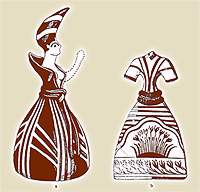 More information on Middle Minoan decoration
(2000-1600 BC) is provided by important finds such as the statuette of the
snake goddess, the fresco of the Blue Ladies from Knossos and the relief fresco from Pseira.
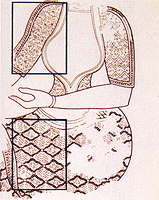
Textile decoration of this period is complex in design, including motifs such as crosses,
interspersed dots, checked squares, while curvilinear designs such as spirals,
which are more difficult in weaving, appear for the first time.
More information on Middle Minoan decoration
(2000-1600 BC) is provided by important finds such as the statuette of the
snake goddess, the fresco of the Blue Ladies from Knossos and the relief fresco from Pseira.
Textile decoration of this period is complex in design, including motifs such as crosses,
interspersed dots, checked squares, while curvilinear designs such as spirals,
which are more difficult in weaving, appear for the first time.
In the Late Minoan period (1600-1050 BC) complex patterns dominated, that is scale patterns, crosses, diamond shapes and the typical serpentine pattern. Very often the whole surface of both female and male garments was covered with geometric motifs, single-theme representations such as flowers and birds or even whole iconographic representations.