 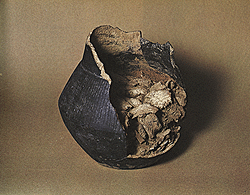
During the Late Neolithic Ι and ΙΙ the burial of the dead in simple pits (inhumation) was more common, as in the Early and Middle Neolithic, with the body in a contracted (foetal) or flexed position. At the same time burials of children in jars have been unearthed, while the collecting of bones continued. During the Late Neolithic Ι the custom of cremating the dead was observed, as is manifest in cemeteries of cremation burials at Soufli Magoula and Platia Magoula Zarkou, situated at some distance from the settlements and dating to the Pre-Dimini Tsangli-Larisa phase. The search for areas at some distance from the settlements for the organization of cemeteries must be linked to a population increase during this period and the lack of space within the confines of the settlement.
At Soufli Magoula, where the custom of cremation burials dates to the Early Neolithic, bones were charred more during cremation, than in earlier times. Burnt bones, usually the skull and part of the long bones of the skeleton, were placed in vases of every day use. These vases were then placed in shallow pits or upon a layer of gravel either in an upright position and covered by other vases or turned upside down. It is thought that these vases were also covered with perishable material (textile or leather), which did not endure with the passage of time. In these burials the offerings of other, small vessels, as well as two figurines were made. Cremation burials were isolated or in a group, that is two or three vases may have been placed in a pit. An interesting case from this cemetery was the burial of a child under seven years of age in a zoomorphic goat-shaped vase. In Platia Magoula Zarkou the cemetery was at a distance of approximately 300 metres to the north of the settlement and the number of burials were over 50. It was only used during the Tsangli-Larisa phase and contained exclusively cremation burials, even in the case of small children. The custom of cremating the dead continued during the Final Neolithic. During the Late Neolithic II, to the already known burial customs, a unique find from the settlement of Ayia Sophia-Larisa can be added. This was the discovery of an artificial, low tumulus (tymvos), whose surface was covered with a thin coat of clay, baked by fire. On the surface of this "clay" tumulus there was an artificial hollow filled with ashes. Beneath this construction parts of two mud-brick buildings the one on top of the other were discovered and the burials of an adult person and a child. The internment of persons next to their house, but under the common ground of the settlement, and the deliberate marking of this grave with the rise of a small tumulus, on which some kind of funerary rites took place, is a significant way of showing respect to the dead and a form of worship. |