 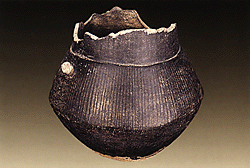
Late Neolithic Ι includes the so-called Pre-Dimini phases and was characterized by a great variety in pottery styles. In Thessaly these styles have been classified by archaeologists as the phases Tsangli-Larisa and Arapi, though they have been recorded in other regions of Greece. Grey ware, monochrome or decorated (grey colour on a grey background),
which was a development in the scraped ware of the Middle Neolithic
and belonged to the Tsangli phase was characteristic of the transition
from the Middle to the
Late Neolithic in Thessaly. It is encountered in finely made vases,
mainly bowls, bell-shaped cups and amphoras. It is more frequent in
western Thessaly, and according to recent archaeometric research seems
to originate from a specialized pottery workshop in the Grizano area. |
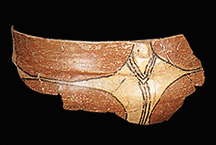
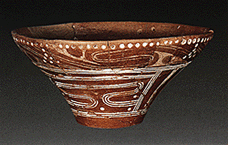
The discovery in the same stratigraphical layer of these two pottery styles in recent excavations, at Platia Magoula Zarkou and Macryichori 2, places the Larisa phase at the beginning of the Late Neolithic and not at its end, as was earlier believed. At the beginning of the Late Neolithic, black paint on a red background, polychrome and matt painted ware, are encounetred, widely disseminated throughout the Aegean area. In the Arapi phase no more gray ware was produced, the black though burnished ware of the Larisa type abounds, with the interior of the vases (biconical bowls, amphoras) now red. In painted ware the following varieties have been observed: a dark brown decoration on a light background, black-on-red and polychrome. Characteristic of this phase is the decoration with black or white on a red background, as well as the appearance for the first time of the spiral as a design motif, that was to predominate during Late Neolithic ΙΙ. |