 

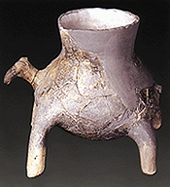
Platia Magoula Zarkou is situated 30 kilometres west of Larisa. The excavations in the area (1974-1990) led to the location initially of the cemetery, and later of the settlement itself situated 300 metres south of it. The cemetery was used only at the beginning of the Late Neolithic I and contained only cremations of children and adults, whose number exceeded 50. The discovery, initially at the cemetery and later at the settlement, of grey (Tsangli phase) and black burnished pottery (Larisa phase) in the same stratigraphical layer, places the Larisa phase at the beginning of the Late Neolithic and not at its end, as was earlier believed. This is of special importance in so as the chronology of Late Neolithic in Thessaly is concerned and has been confirmed at Soufli Magoula and Makrychori 2. |
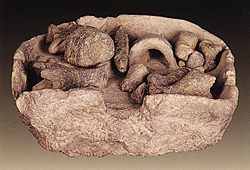
The settlement was inhabited from the end of the Early Neolithic up
to the beginning of the Late Neolithic I (Tsangli-Larisa phase). After
being abandoned for thousands of years, it was re-inhabited during the
Early Bronze Age (3rd millenium BC). Architectural remains of the settlement
were discovered at a depth of 4-5 metres from the surface of the ground
today, buried under the alluvian deposits of the Peneios river. Geological
research in the area has shown that the settlement was organized towards
the end of the Early Neolithic Period near the river bank, providing
particularly fertile soil for cultivation. |