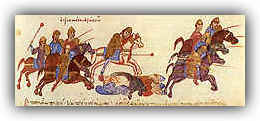
 to submit the annual payment of tribute to the neighbouring state. The Byzantine Emperor then called on the Russian sovereign Svjatoslav.
 The Russian presence in the Balkans, however, created new problems for the Empire that were resolved by John Tzimiskes. In 971, by means of an expedition led by himself, he managed to turn his Russian opponent away from the region. Thereafter, the territory of the Bulgars was annexed by the Empire and integrated into the administrative system of Themes.
Shortly after, a new revolt broke out. It was led by Komes (Earl) Nicholas' four sons, which became known as the movement of Kometopouloi (sons of the Komes), and resulted in the re-establishment of the Bulgarian state by the youngest son Samuel, centred on Ochrid. Continuing the war against the Byzantine State, Samuel moved on Thessalonike (in 995) and two years later he marched into southern Greece. He reached as far as the Peloponnesos, sacking and destroying towns on his route. The same year, the Byzantine army, with Nikephoros Ouranos at its head, achieved its first decisive victory near the Spercheios river. Samuel himself was severely wounded and had a narrow escape.
In the years that followed, the Emperor Basil II, after a series of systematic and continuous campaigns, managed to confine Samuel to the western regions of the Bulgarian State. In 1014 at Kleidi the Bulgar army was completely defeated. According to contemporary sources, 15,000 Bulgar soldiers were captured there. Basil II ordered them to be blinded, and Samuel, unable to bear the sight of his blinded soldiers, died a few months later. Four years later, the Bulgarian state was divided into two Themes, the Bulgarian patriarchy was abolished and its place was taken by the autonomous archdiocese of Ochrid.
After 44 years of cruel confrontation, the Bulgar subjugation had been completed and Basil began a triumphant march through the central and southern regions of his Empire, the climax of which was his visit in Athens to the Church of the Theotokos (the Virgin Mary) in the Parthenon.