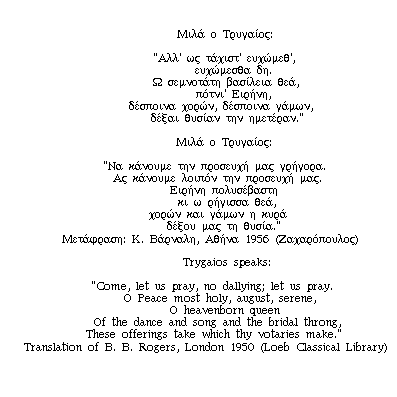
Aristophanes was born in Athens ca. 445 BC. from Athenian parents and
died in 358 BC. He wrote in total 44 comedies of which only 11 survive
- among them the Peace.
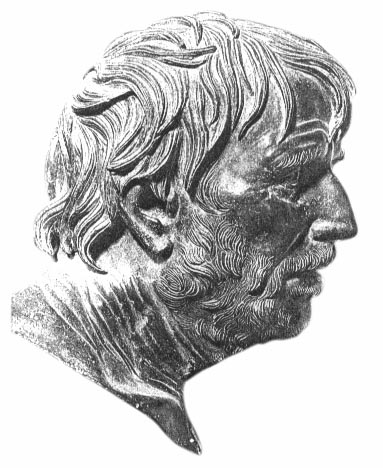 When Dionysius, the tyrant of Syracuse, asked Plato to recommend him
a book which would help him to get to know Athens, the great pholosopher
sent him Aristophanes' comedies. Indeed, no other text from antiquity gives
us a more vivid idea of what Athens was at the end of 5th - beginning of
4th century BC.
When Dionysius, the tyrant of Syracuse, asked Plato to recommend him
a book which would help him to get to know Athens, the great pholosopher
sent him Aristophanes' comedies. Indeed, no other text from antiquity gives
us a more vivid idea of what Athens was at the end of 5th - beginning of
4th century BC.
However great difficulty the modern reader or spectator may have when
confronted with the poet's references to people or events of that era s(h)e
can, nevertheless, enjoy the aristophanian comedies exactly because the
human characters and situations have striking similarities throughout mankind's
history.
 His aim is to complain to Zeus and ask for peace for the
benefit of Greeks. When he reaches the sky, Hermes informs him that the
Gods have withdrawn to the highest point of the sky dome, frustrated by
the opponents' persistance in hostilities. Instead of them only the God
of War remains who has shut Peace in a cave and is now preparing to put
all cities in a mortar to destroy them. Trygaeus summons all Greeks and
the common people mainly to help him move the rock which seals the cave's
entrance and set Peace free. They manage to do that in their third attempt
and Peace comes into view accompanied by two beautiful virgins: the godess
of fruit "Opora" and the godess of official ceremonies and feasts "Eorte".
The rest of the play is a hymn to peace, a feast coming after the liberation
of Peace. The joy of life and creativity is what prevails. After the triumph
and in an atmosphere of enjoyment Aristophanes takes the chance to ridicule
war-mongers and arms dealers.
His aim is to complain to Zeus and ask for peace for the
benefit of Greeks. When he reaches the sky, Hermes informs him that the
Gods have withdrawn to the highest point of the sky dome, frustrated by
the opponents' persistance in hostilities. Instead of them only the God
of War remains who has shut Peace in a cave and is now preparing to put
all cities in a mortar to destroy them. Trygaeus summons all Greeks and
the common people mainly to help him move the rock which seals the cave's
entrance and set Peace free. They manage to do that in their third attempt
and Peace comes into view accompanied by two beautiful virgins: the godess
of fruit "Opora" and the godess of official ceremonies and feasts "Eorte".
The rest of the play is a hymn to peace, a feast coming after the liberation
of Peace. The joy of life and creativity is what prevails. After the triumph
and in an atmosphere of enjoyment Aristophanes takes the chance to ridicule
war-mongers and arms dealers.