|
The Olympic stamps
The inability of the Greek State to cover the expenses for the organization of the first modern Olympic Games led the organizing committee to look for 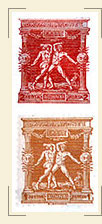 alternative ways of financing. Private sponsoring covered a large part of the cost for the construction of sports installations in the Greek capital. Among these private sponsors, Georgios Averof offered a considerable amount of money for that time, about one million golden drachmas, whereas another 400,000 were collected from the selling of a special series of stamps, which was issued by the Greek State for that purpose. alternative ways of financing. Private sponsoring covered a large part of the cost for the construction of sports installations in the Greek capital. Among these private sponsors, Georgios Averof offered a considerable amount of money for that time, about one million golden drachmas, whereas another 400,000 were collected from the selling of a special series of stamps, which was issued by the Greek State for that purpose.
The idea to issue Olympic stamps belonged to certain Greek philatelists and was adopted by the organizing committee and then by the Greek State. In this first Olympic series are included 12 stamps of a different value (1, 2, 5, 10, 20, 25, 40 and 60 cents, 1, 2, 5 and 10 drachmas), which have eight different representations. The design of the stamps was assigned to the French artist A. Gigueron and their themes were inspired from the Greek Antiquity and the ancient Olympics. The representations include the statue of Nike of Paionios and Myron's Discobolus (discus thrower).
This was not simply the first series of Olympic stamps, but the first time that a sports event became the main theme of a series of stamps throughout the world. The stamp, a British invention, which was put into force in 1840, was quickly adopted by many countries throughout the world. France and Brazil issued the first series of stamps in 1843, the USA in 1847, and Greece in 1861. It was a new and completely different system of postage payment, whose use soon acquired an additional value, that of a collector's item. The collection of stamps spread very quickly and from the late 1860s the first philatelic societies were formed in America (USA 1866) and in Europe (Germany 1869).
The first Olympic stamps issued by the Greek State drew the attention of philatelists in the whole world, who offered money to the organization of the Games. However, despite the fact that the financing of the Games has been a critical issue in all the Olympic organizations, the practice of issuing a special series of stamps for the Olympic Games was adopted in the 1920 Antwerp Olympics. Then, the Belgian State issued the second Olympic series that consisted of three stamps. Ever since, every host city has followed this practice. It should be noted that the stamps of the first organization (1896) were re-issued by the Greek State in 1996, on the occasion of the Centenary Games.
Apart from the interest in stamps, which keeps pace with the development of philately in modern times, the organizers of the Olympics have created a number of memorabilia (e.g. pins, mascots, posters) for each Olympic organization. Particularly popular and valuable as collector's items are the Olympic coins. The first Olympic coin was minted by Finland in 1951 on the occasion of the 1952 Helsinki Olympics. It was a silver coin, of a worth of 500 Finnish marks, which bore the representation of an olive branch on one side and the five interlinked Olympic rings on the other, with the name of the host city and the number of the Olympics engraved on it. The minting of Olympic coinage has been adopted ever since by every country that hosts the Olympics. It is characteristic that 24 different coins were minted for the 1972 Munich Olympics and 45 for the Games of Moscow in 1980.
The interest of the collectors in the Olympic memorabilia led the IOC to the creation of three special federations. One federation for stamps (International Olympic Philately Federation - FIPO), another for coinage (International Olympic Numismatic Federation - FINO) and a third for other objects (International Olympic Memorabilia Federation - FIMO). All the memorabilia from the first Olympic organization of the modern times until today are exhibited in the Olympic Museum that the IOC has created in Lausanne.
|