|
 The journeys of the Olympic flame
The entrance of the Olympic flame in the Helsinki Olympic Stadium was one of the most touching moments in opening ceremonies. The last 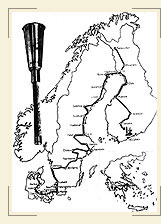 torchbearer was Paavo Nurmi. After lighting the altar that had been constructed in the competition site, he handed the flame to the other "flying Finn", Hannes Kolehmainen. He lit a second altar that was situated high on the stadium's tower. Before that, the flame had covered a distance of 3,600km approximately. What is more, for the first time it was not carried through land, seeing that the Soviet Union refused to allow the passing of torchbearers from its soil. Therefore, from Athens the flame travelled by airplane to Denmark and from there by ship to Sweden. Then, runners for the most part, carried it to Helsinki. torchbearer was Paavo Nurmi. After lighting the altar that had been constructed in the competition site, he handed the flame to the other "flying Finn", Hannes Kolehmainen. He lit a second altar that was situated high on the stadium's tower. Before that, the flame had covered a distance of 3,600km approximately. What is more, for the first time it was not carried through land, seeing that the Soviet Union refused to allow the passing of torchbearers from its soil. Therefore, from Athens the flame travelled by airplane to Denmark and from there by ship to Sweden. Then, runners for the most part, carried it to Helsinki.
The Olympic flame appeared for the first time at the opening ceremony of the 1928 Olympics. The practice was repeated in 1932. Four years later the ritual was complemented with the lighting ceremony in ancient Olympia and with the torch relay. In this first journey the flame was transferred from ancient Olympia to Athens, to the Acropolis and the Panathenaic Stadium. Then approximately 3,000 runners transferred it to Berlin, passing through Greece, Bulgaria, Yugoslavia and Austria. The rituals were repeated in 1948 and the next year they were adopted by the IOC. However, in 1948, Greece was in the midst of a fierce civil war. As a result, the lighting ceremony, which for the first time took place at the sanctuary of Hera, was carried out in a climate of insecurity and intense military guarding. It was the first time that the flame was not carried by runners to Athens. Instead, it was transferred to the nearest port and from there it travelled to south Corfu, an island that did not experience the armed aspect of the civil war. Therefore, a local torch relay was organized in Corfu and from there the flame was transferred by ship to Bari, Italy. Runners carried it to the west coasts of France passing through regions of Switzerland, Luxembourg and Belgium and then it was transferred by ship to Great Britain.
In 1956 the Olympic flame travelled by airplane again, albeit for different reasons with regard to 1952. The Games were held in Melbourne, Australia but also in Stockholm, which hosted the equestrian events due to the complex Australian legislation regarding the entry of foreign animals. Therefore the flame was transferred by ship from Athens to both cities.
Of singular splendour was the carrying of the flame for the Olympic Games of 1968 in Mexico, of 1976 in Montreal and of 1980 in Moscow. In the first case, the Olympic flame travelled for the most part by ship, following the itinerary of Christopher Columbus from Barcelona and Puerto de Palos to Bahamas and from there to Mexico. In 1976 the Olympic flame was transferred from the Panathenaic Stadium to the Monreal Olympic Stadium through a tele-transport device. In 1972 the flame was transferred in Munich exclusively by runners, for the first time after 1936, passing through Greece, Turkey, Bulgaria, Romania, Yugoslavia, Hungary, East and West Germany. The flame of the 1980 Moscow Games was also transferred exclusively by runners.
|