|
 The Nadi brothers
Fencing
is one of the sports that appeared in the Olympic Games from
the very first organization, at Athens in 1896. 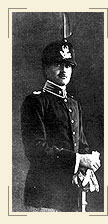 The
first Olympic winner in fencing was the French athlete Eugne-Henri
Gravelotte. His victory reflected the tradition of his country
in a sport, whose characteristics as a modern sport started
to take shape during the Renaissance, especially in France
and Italy. These countries dominated fencing until the 1930s,
almost monopolizing the medals in the Olympic Games. What
is more, at the Games of Antwerp, in 1920, two brothers from
Italy, Nedo and Aldo Nadi had prevailed (and with them the
team of Italy) in five of the six fencing events. The
first Olympic winner in fencing was the French athlete Eugne-Henri
Gravelotte. His victory reflected the tradition of his country
in a sport, whose characteristics as a modern sport started
to take shape during the Renaissance, especially in France
and Italy. These countries dominated fencing until the 1930s,
almost monopolizing the medals in the Olympic Games. What
is more, at the Games of Antwerp, in 1920, two brothers from
Italy, Nedo and Aldo Nadi had prevailed (and with them the
team of Italy) in five of the six fencing events.
Nedo Nadi was born in Livorno, Italy on 6 September 1893.
He was the son of Beppe Nadi, one of the most eminent Italian
fencers of the 19th century. Nedo learnt from an early age
to manipulate the fencing weapons in his father's gymnasium.
In 1911 he participated for the first time in international
games and the following year he won his first gold medal in
the Games of Stockholm. In 1916 the Olympic Games were not
held due to World War I. He was decorated for his participation
in battle. In Antwerp, in 1920, he dominated fencing, winning
five of the six events: individual foil, individual sabre,
team pe, team foil and team sabre. With five gold medals
in one organization, an accomplishment similar to Nurmi's
in the 1924 Paris Games, Nedo Nadi held for decades a record
that could only be broken by the seven gold medals of the
swimmer Mark Spitz in the 1972 Munich Games.
In the Olympic Games of Antwerp Nedo Nadi was fellow athlete
but also the opponent of his brother Aldo. Together they won
two of the three team fencing events, whereas Aldo was second
Olympic winner in the individual sabre event, in which his
brother came first. After Antwerp they participated in professional
games in Europe and America until the mid-1930s, when they
gave up competitive fencing. Nedo taught fencing in Buenos
Aires and in 1935, upon his return to Italy, he was designated
president of the Italian fencing federation. He died in Rome
at the age of 47, on 29 January 1940, having been a hero of
World War I, an Olympic winner and one of the most important
fencers of modern times.
Aldo, who was born on 29 April 1899 in Livorno, after a brilliant
career as a professional fencer, moved to the USA in 1935
and taught in his own school, first in New York and then in
Los Angeles, where he died, on 10 November 1965.
|