|
 The
stadium The
stadium
The Panathenaic Stadium or Kallimarmaro not only does it symbolize
the long-established tradition of Greek sport, but is also
closely associated with the 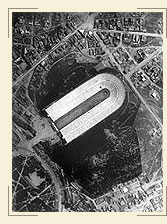 history
of the city of Athens. history
of the city of Athens.
The first reference to it was made during the period that
the city was governed by Lycurgus (330-336 BC), who decided
to create a sports area for the city's inhabitants. The area
of Ardettus was regarded as the most appropriate being the
point where the hills Agras and Ardettus converge, near the
Ilissos river.
After the necessary works the field was surrounded by a stone
enclosure. A few wooden seats were, which were reserved to
honoured persons (priests, ambassadors, sovereigns, children
of men who had fell in battle), as opposed to the rest of
the spectators who sat on the rocks of the two hills.
Several centuries later, in 131 AD, at the initiative of Herodes
Atticus, a grand stadium of a capacity of 50,000 spectators
was built on the same site. The stadium was constructed in
a manner that the spectators would be protected during the
beast fights and the tiers were divided in two landings having
23 rows of marble benches each.
As centuries went by the Stadium was being abandoned. The
marbles were removed in order to be used in the construction
of other buildings or in making whitewash.
Many years had to go by before the stadium would regain its
former glory. So in 1870 the Zappeian Olympiad was hosted
there, and 5 years later, after the space was cleaned and
properly arranged.
When in 1894 at the International Sports Congress held in
Paris it was decided that Athens would undertake the revival
of the Olympic Games, the need to create a stadium was imperative.
Then everybody thought of the Panathenaic Stadium.
The biggest problem was to raise the necessary funds for the
stadium's reconstruction; therefore, a panhellenic fund-raising
was decided. However, the largest amount was granted by the
Greeks of Alexandria and by George Averof, the president of
the Greek community, who contributed 585,000 drachmas.
The designs for the new stadium were based on the excavations
by Ernest Ziller dating from 1873 and were materialized by
hundreds of workers. Yet, the problems that arose were many,
of pecuniary nature mostly.
Thanks to further help by George Averof the necessary amount
was raised, but precious time had been lost for the preparation
of the site within the scheduled time. The contractor Periklis
Kyriakos, professor at the National Technical University of
Athens, announced in January 1896 that he could not deliver
the stadium with its three quarters overlaid anew with marble,
as was the initial plan.
It was therefore decided that only the first four rows would
be covered with marble and the rest of the tiers to be wooden.
They were painted white, so that there would not be incongruous
with the rest. Moreover, instead of a portico, wooden pedestals
were placed bearing plaster copies of ancient sculptures.
As far as the track was concerned, this was assigned to the
British architect Charles Perry, who was considered at that
time the specialist par excellence in such works.
At the same time, five bridges-accesses to the Panathenaic
Stadium and six entrances were created, due to Ilissos river.
Eventually the Kallimarmaro had 60 tiers divided into two
zones, the upper and the lower one.
In the midday of 25 March 1896 the opening of the Olympic
Games took place with all solemnity and was attended by over
60,000 Athenians. The hosted events were athletics, gymnastics,
wrestling, weightlifting and the marathon finish. The other
sports, cycling and tennis, were carried out in the velodrome
at Neo Faliro (Kara•skaki stadium). Shooting took place at
the Shooting Gallery of Kallithea, which, like the velodrome,
had been constructed in view of the Games, and fencing at
the Zappeion.
Right after the end of the Games the works at the Kallimarmaro
resumed at a slow pace and it was ready short before the Interim
Olympic Games of 1906. Marble was placed everywhere and infrastructure
works were carried out giving to the stadium its present form
- with certain minor differences.
|