 |
|
The technological remains provide information on the agrarian economy and the simple social organization of the Middle Helladic period. The development of the arts is characterized by a considerable retrogression in comparison with the Early Helladic period, by the rareness of the raw materials and the lack of high artistic creation such as the artistic expression of Minoan Crete. This general image of retrogression is due to presumably important but still unknown economic and social factors which led the populations of Mainland Greece to incapacity of social and economic administration. Thus, they were unable to ensure the necessary raw materials and to promote the development of the arts at a great extent. The use of metals appears rather restricted. Metal finds are sparsely unearthed in Middle Helladic settlements and graves. The metal grave goods are rare because metal objects were very few to be offered as grave gifts to the dead. The rareness of metals is the reason metal finds are rarely found in settlements. This shows that the metal tools were not thrown away to no purpose but were almost all recycled to be reused. During the largest part of the Middle Helladic period there is also total absence of rare materials such as semiprecious stones and ivory. |
 |
|
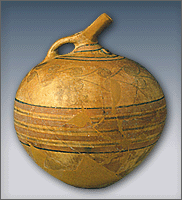
Beaked bird askos with
polychrome
decoration from the Grave Circle A, grave II, at Mycenae. | |
|
Most information on the artistic creation and technology of the Middle Helladic period derive from the study of pottery, the production of which implies important technological and artistic innovations despite its uniformity and conservatism. The great diffusion of certain Middle Helladic pottery wares in different regions of the Aegean indicates the considerable commercial competitiveness of certain regional workshops. During the last phase of the Middle Helladic period, particularly during the Shaft Grave period, a larger number of vases of improved quality, bronze tools and weapons,as well as a great number of jewellery made of precious metals and other rare materials are found in the graves. This rich artistic production, the advanced technology and the richness of the grave goods show that apart from articles of everyday usage a constantly increasing reserve of economic resources could now be offered as grave gifts. In addition, a great number of imported articles shows the relation of the Mainlanders with the Minoan culture of Crete as well as the more intense contacts with the Cycladic culture. The technologies of pottery, metalworking and other arts of the Middle Helladic period reached the fine artistic creation of the Mycenaean period through these fruitful interconnections. |