 |
||
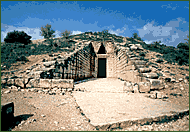
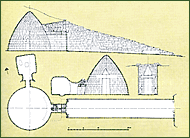
The tholos tombs are subterranean circular buildings which are comprised of the tholos and a long dromos. The tholoi were built of stone-mudbricks which were placed in rows according to the corbelling system. This burial type derived probably from Crete where it existed already from the Early Minoan period (3000-2000 BC) and was transferred to mainland Greece toward the end of the Late Helladic I period (1550-1500 BC) through Messenia where the earliest tholos tombs have been found. According to another opinion, the tholos tombs are just a stone built version of the Helladic tumulus. The tholos tombs which have been found on mainland Greece amount to 120. Of all these, the fourteen larger ones are considered significant architectural creations as the tholos constructions presented serious static problems when their diameter exceeded 6 metres. Specifically, the stomion was susceptible to collapsing because of the excessive weight of the lintel which sometimes reaches 120 tonnes. A protective technique which was applied to prevent this was the invention of the relieving triangle which bore the weight of the lintel on the jambs and the sides of the tholos. All the tholos tombs of mainland Greece were found plundered partly or completely. Therefore we do not have a clear picture of the burial customs. The pits found in their ground served as graves or as ritual installations for the reception of funeral libations and offerings. Sometimes rectangular chambers were added to the tholos tombs. These rooms were used as funeral chambers, as a burial of a woman at Archanes reveals. Two graves of this type have been found on mainland Greece, the "Treasury of Atreus" at Mycenae and the "Treasury of Minyas" at Orchomenos. In the latter, the roof of the side chamber is covered with a limestone slab with relief decoration. The entrance of the tholos tombs were blocked mainly by a wall and very rarely by a door. Extra care was given to the construction of the facade despite the fact that the entrance was visible only for a small period from the moment of the completion of the grave until the first inhumation. The sumptuous decoration of the facade of the Treasury of Atreus constitutes a unique example. The dromos was formed according to the size and the quality of the construction of the graves, as a small passage hewn out of the rock or a well built stone construction. After each burial the external end of the dromos was closed and its interior was filled in with earth. The graves were covered by an artificial earthen mound and stones which protected the construction from wear and tear. This imposing earthen mound functionned as a burial stele. The use of tholos tombs ceases in the Late Helladic III C period (1300-1200 BC). From this period and until the end of the Mycenaean period the chamber tombs dominate along with older grave types, probably because the new economic circumstances did not allow the construction of such complex burial monuments. |
 |
|
|
Mycenae. Tholos tomb,
known as the "Treasury of Atreus". |
||
 |
||
|
Mycenae. Section and plan
of the tholos tomb of Areus. |
||