 |
||
In contradiction to the Middle Helladic period which lacked completely religious signs, during the following period on mainland Greece religion dominates over most social activities. The first evidence of Mycenaean cult come from the shaft grave period. The beliefs of this period are clearly influenced by the religion and cultic ritual of Minoan Crete. The religious parallels of these two Aegean cultures are revealed by the presence of the sacred symbols and similar cult objects. During the mature phases of the Mycenaean period (Late Helladic III A-III C) the cult ritual acquires a stereotype form. The decipherment of these religious acts and their interpretation are now supported by a number of iconographic representations on frescoes, seals and gold rings. The interpretation of these representations which are often codified at a considerable extent is completed by the more rich and clear Cretan iconography. But, the influence of Minoan Crete concern mostly the ritual of the cult and less the main religious principals. Along with the cult of the Minoan female goddess which is distinguished by the intense eastern elements, the cult of other female or male deities with names of Indo-European origin is ascertained mainly by written sources. The linguistic and archaeological evidence reveal that in the course of the Late Bronze Age the pantheon and the main cult figures of classic Greece had already been formed. The evidence on religious representations is completed by fragmentary but clear texts from the tablets of Pylos, Knossos and Thebes. The relative texts concern administrative matters of the religion, lists of offerings to sanctuaries, the possessions and duties of the priesthood. As in Minoan Crete, the religious and political power appear interdependent if not identical on the highest level of the hierarchy. The absence of particular buildings devoted exclusively to cult shows that the sacred rituals usually took place in open spaces or in peak sanctuaries. The sacred buildings which occur in very few representations had the form of a shrine of a tripartite architectural design in the country. The fact that Mycenaean shrines have been discovered under temples of Antiquity constitutes a clear indication that certain places of cult of the Mycenaean period maintained their religious property in later periods as well. Apart from architecture, iconography and the written texts, the Homeric epics are also used as information sources on the Mycenaean religion despite the fact that the evidence of Homer comes mainly from later periods. The religious traditions of Homer associate the Mycenaean cult with the cult and burial customs of Classical Greece and particularly with the cult of heroes. |
 |
|
|
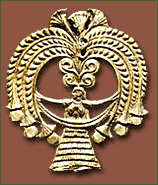
Mycenae, Grave Circle
A, grave III.
Gold head of a silver pin with a goddess. |
||