 |
||
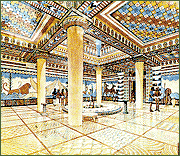
The palace of Pylos is built on the hill of Ano Englianos, 17 kilometres north of Pylos. The hill is naturally fortified since it rises between ravines and has a view of the gulf of Navarino. The palace of Pylos is the only palace which is not surrounded by Cyclopean fortification walls. The palace complex is composed of different buildings. The best preserved wing is the royal residence. The affluence phase of the palace is considered to be the period between 1300 BC and 1200 BC. The great number of Linear B tablets found in the palace archive contributed decisively in the decipherment of the Mycenaean writing. Great amounts of wood were used for the timbering, the pillars, the pier and door partitions and the roofs. The interior walls and the floors of the rooms were covered with limestone plaster and frescoes. Two of the buildings of the palace, the central and southwestern, were two storeys high. Pylos concentrates the largest number of Minoan elements of all the Mycenaean palaces. The principle ones are the absence of fortification and the carving of the double axe, a Minoan religious symbol, on a limestone floor block. The oldest building is the southwestern one and it is conventionally named "palace of Neleus". This is composed of an antechamber with three pillars, a four-pillared banquet hall, a bathroom and a dresser in which a large number of cooking pots were found. The wine-cellar belonged to this wing. The royal residence was in the central building. Its apartments were developed around an internal court. The royal apartments were accessible via a propylon. The megaron was the main part of the palace which was composed of a pillared stoa, the vestibule and the main megaron. In the centre of the megaron was a large circular hearth covered with decorated plaster. The hearth was flanked by four wooden pillars and opposite the hearth stood the royal throne. Around the megaron were corridors, stairwells, dressers and oil storerooms, a small waiting room and a room with a bathroom and a fixed bath-tub. In the so-called "Queen's Megaron" was a smaller hearth, a bathroom and a peculiar tower-like construction. The palace archive was composed of two adjacent rooms in which approximately 1.000 Linear B tablets were found. These inscriptions are systematically archived accounting lists and lists of products and people which served the wanax. The northeastern building which is composed of six rooms and one corridor and a colonnaded shed, was reserved for artisanship activities. In this building was a small square room with an open facade which is characterized as a shrine, a storeroom, a workshop and an arms depot in which hundreds of arrowheads were found. In the workshop were inscribed tablets while the dresser comprised 850 vases. Opposite this area was a large wine cellar where 35 wine pithoi were found. Sixty clay sealings that were found in the storeroom bore the Linear B ideogram which represents wine. At the end of the 13th century, around 1200 BC, the palace of Pylos was destroyed by fire. The inhabitants had managed to save the most valuable objects and the furniture. After the destruction of the palace, the hill was reoccupied until the end of the Geometric period. |
 |
|
|
|
Pylos. Reconstruction of the throne-room
of the megaron. |
|
 |
||
|
Pylos. Plan of the palace.
|
||