 |
||
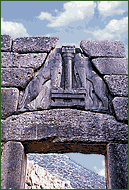
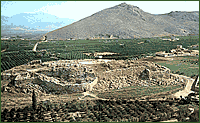
Our knowledge on the settlements of the Mycenaean period come mainly from the excavation research of Mycenaean sites and the surface surveys, which provide a picture of the area and density of Mycenaean settlement. The cemeteries -even those which may not be close to a settlement- indicate the existence of a nearby settlement. As far as the settlement of the early Mycenaean period is concerned, there is very little evidence since these settlement phases have been covered or even destroyed by the intensive building activities of the later phases. The phenomenon of the lack of settlement evidence of this period is so extensive that it may even be due to a massive abandonment of the settlements. However, the excavated parts of certain Late Helladic I and II settlements such as Tsoungiza, Peristeria, Nichoria and Agios Stephanos reveal the existence of early Mycenaean settlements with a town planning similar to that of the Middle Bronze Age. The archaeological evidence on the settlement of the mature Mycenaean periods are certainly of a larger number. There is also the information that results from the written sources of the period and specifically from the decipherment of the placenames on the tablets of Pylos, Knossos and Thebes. The most typical building remains of the period of prosperity are the fortified citadels which were built around the middle of the 14th century BC in the most significant Mycenaean centres. The walls of the Mycenaean citadels were built with the Cyclopean masonry style and their entrances were imposing gates composed of large stones. The best researched citadels of Mycenae and Tiryns within the walls of which important buildings have been built, reveal that the citadels comprised the administrative seats of the Mycenaean kingdoms. At the highest peaks of the citadels the kings' palaces were built. The Mycenaean palaces are related to the Minoan ones as far as their initial conception is concerned. The functional needs that they had to serve were common, that is to say they had to include the private residences of the leaders as well as workshops, magazines and reception halls for the public. Parallels with the Minoan palaces are also observed in the magnificent internal decoration which included frescoes and stone lining. But their planning does not suggest the complexity and the large area the Minoan palaces occupied. The palaces of mainland Greece were more simple buildings that occupied a small area, built around a central megaron, which constituted an earlier element of Helladic architecture. The subjects of the Mycenaean kingdoms lived in small settlements which were situated at the foot of the citadels in the nearby regions and in the countryside. They were built on mountain slopes and hillocks while positions close to fertile valleys and springs were preferred. In addition, the coastal sites and ports were of great importance for the economy and trade. Some Mycenaean sites were already inhabited during the Early and Middle Bronze Age but also in the Late Helladic III A period when many new settlements were built. But the puzzle of the Mycenaean settlements is not clear yet since the research that has been conducted to date has focused on the most impressive monuments of the Mycenaean time, the citadels and the cemeteries. which are rich in finds. Thus there are many questions to be answered on the area of the settlements, their planning and their evolution in the course of the historical periods. In order to collect and combine archaeological, topographic and literary evidence and taking into account the fact that the Homeric epics are concerned with the historical reality of the Mycenaean period, the Mycenaean sites are often identified with the placenames mentioned in the Homeric "Ship Catalogue". But, these identifications are often risky since the geographical information included in the Homeric epics derive from different periods (as many other elements) and were mainly formed by persons which did not know the regions of the Mycenaean world by personal experience. |
 |
|
|
Mycenae. The relieving triangle
of the Lion Gate. |
||
 |
||
|
Tiryns. Aerial view of the citadel.
|
||
 |
||
|
Kazarma, Argolid. Mycenaean bridge.
|
||