 |
||
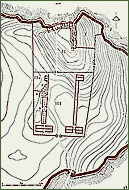
The Mycenaean citadel of Gla is situated on a rocky hillock on the northeastern part of the Kopais plain. The Kopais is a natural lake that had been artificially drained during the Mycenaean period. Before the drainage of the lake the citadel of Gla was an island. As revealed by the ceramics found on the hillock, the earliest settlement in this site dates to the Neolithic period. The Mycenaean fortification wall of Gla which was built roughly at the end of the 14th century BC with the characteristic Cyclopean masonry has the largest circumference of all the other Mycenaean citadels enclosing an area of 3 km2. The building peculiarity of the fortification wall is the serration of some parts of the wall, an element that aimed at the greater sturdiness of the walls in the bedrock. According to another opinion, the serration represents the connections of parts of the wall and is simply attributed to the different stages of the evolution of the building program. The citadel has four gates. The best preserved one, the southwestern gate, has outposts on both sides. A find of this region to which great importance is attributed, a fragment of stone horns of consecration, which are the emblem of the Minoan palaces, reveals the relation of Mycenaean kingdoms with the Minoan culture. Although the masonry of the fortification wall places Gla in the Mycenaean citadels, the kind of the buildings and the use of the citadel are completely different from the others. Gla was not a fortified settlement that included the palace of the king but a place devoted exclusively to the protection of the state treasure. In this case, the treasure were the agricultural products and the merchandise that were kept in the buildings of the citadel. The members of the leadership or its representatives which lived there directed the distribution and sale of the products while they also supervised the drainage works. At the northeastern end of the citadel the so-called "palace", an angular complex which is developed in two wings with small rooms of exactly the same architectural design is built. Many researchers consider this complex as the palace of the Mycenaean wanax while others the residence of two higher officials. In the central part of the citadel was a building complex which is named the Agora. This complex is composed of symmetrical buildings with large rooms. Along the long sides of the rooms were built shallow dykes. In these rooms pithoi with large quantities of charred cereals were discovered. Although the buildings of the Agora were destined presumably for the storage of agricultural products, their walls were decorated with frescoes. Apart from the various building complexes, the citadel included a large unbuilt area. The citadel of Gla had a long life. The buildings were destroyed by fire in roughly 1200 BC. After the collapse of the drainage works and when the citadel was again closed up by the waters of the lake and the swamps, the fortress was no longer needed; consequently the hillock was never reoccupied. |
 |
|
|
Gla. Plan of the central area.
|
||