 |
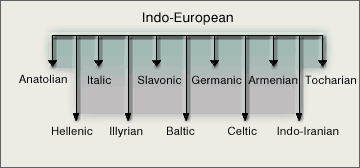
The discovery of inscribed tablets in the excavation site of Knossos verified the organized use of an advanced writing system which was initially considered to have expressed, as the previous ones, a pre-Hellenic dialect. The decipherment of the Mycenaean Linear B in 1953 by M. Ventris and J. Chadwick revealed - to the great surprise of the Greek scholars of that time - that the syllabic signs of Linear B composed words of the Greek language. |
|
The Mycenaean language is the earliest known dialect and it also includes many pre-Hellenic elements. It does not fully correspond to any of the later dialects but it is most similar to the Arcado-Cypriot. Moreover, its vocabulary includes words of Greek origin which do not appear in the ancient Greek language. It is considered that these words disappeared in the course of the Geometric and Archaic period. The syntax of the Mycenaean texts is very difficult to study since the texts of the tablets are mainly simple lists. Elements of structure occur only on one tablet from Pylos, on which a temporal clause begins with o-te (when), while in another part the accusative case of reference, known from ancient Greek, is employed. The singular, plural and dual numbers coexist but are often used in the same way because in all cases they function as titles. Furthermore, structural incoherence due to the epigrammatic nature of the texts or to careless mistakes frequently occur. |

|
|