 |
||
The archaeological finds resulting from surface surveys and excavations of settlements and cemeteries constitute valuable and unique sources in the effort of deciphering the economic organization and social composition of the insular communities of the Aegean during the Bronze Age. In the course of the Early Bronze Age one or more large settlements with an early urban character and 300-1500 persons are developed in the big islands of the eastern Aegean. Conversely, in the Cyclades are many small settlements composed of a few families, 50 persons minimum. From the Middle Bronze Age, mainly in the Cyclades, the sparse population is concentrated in one or two of the large and better organized settlements on each island which evolve into populous urban centres during the Late Bronze Age. After the collapse of the Mycenaean centres (about 1200 BC) populations migrate from mainland Greece to the islands of the central and south Aegean bringing changes in demography with the growth of population and the foundation of new settlements. The social composition of the insular communities is closely related with the possibilities of each island for economic development, technological specialization, navigation and trade, the accumulation of wealth and the way it is distributed in each community as well as with the intensity of the external cultural influences at various periods of time. Clear indications of social stratification are recorded already from the Early Bronze Age during which a political-administrative authority and a wealthy class of skilled craftsmen and merchants is distinguished. From the Middle Bronze Age a new social-economic power is formed, the seamen, which take action in the transit trade initially with the Minoans and during the Late Bronze Age with the Mycenaean merchants. The burial customs of this period reflect the respect to the value of human life, belief in life after death and even fear of the dead. Early and Middle Bronze Age organized cemeteries of cist graves and vaulted chamber tombs during the Late Bronze Age, funeral ceremonies as well as grave-goods depending on the age, sex and social status of the deceased, express the psychism and semeiology of the independent, forceful and flexible islanders of the Aegean.
|
 |
|
|
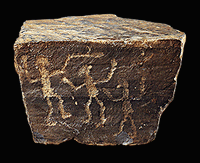
Naxos. Marble plaque with repousse representation
of human figures.
Early Cycladic II-III. |
||
 |
||
|
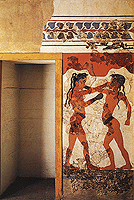
Thera, Akrotiri-Sector B. Boxing boys.
Fresco from room B1. |
||