 |
||
The burial customs of the island in the Late Bronze Age are little known, as few burials -compared to the rich settlement remains of this period- have been found and their dating is indeed very difficult. From the evidence available to date we can observe that the grave types present a harmonic evolution from the earlier cycladic graves and that at the same time they bear more and more manifest Mycenaean influences. As indicated by the cemetery at Ailas on Naxos, the burials in cist graves continue until the Late Cycladic I period, while at Phylakopi and Agia Irini Mycenaean type shaft graves have been found. From the transition to the Late Bronze Age a type of chamber tomb prevails. It appears to be mainly a Mycenaean influence but in the specific region it presents a long tradition from the Early Cycladic III C period. The majority of the chamber tombs with a dromos have been indicated in Late Cycladic cemeteries of Naxos, in the sites Aplomata, Grotta and Kamini, in which the unique case of incineration has been traced. Small groups of vaulted chamber tombs have also been found in Lagada on Melos and on Kimolos. The graves of Naxos and their grave goods show that the burial customs of the Cyclades during the Late Cycladic III C period were similar to the Mycenaean ones. As on mainland Greece, the most eminent dead were buried among sumptuous grave goods, usually vases and weapons. They were dressed with extravagant clothes and adorned with valuable jewellery. The ceramic grave goods derived from the regional production of Naxos, but some come from Attica, while others are identified as decoration impacts of the eastern Mediterranean. The graves of Agia Irini provide the most information on the burial customs of this period and also on their evolution from the Middle to the Late Bronze Age. At Agia Irini the use of the Middle Cycladic cist graves ceases but the pithos burials within the limits of the settlement continue for a certain period of time. During the transition phase to the Late Bronze Age the cist graves with built walls appear. This type seems to be an evolution of the simple cist grave with stone slab lining. Two of this kind of graves have been constructed with particular care. One of them is covered with an earthen tumulus, surrounded by a stone wall whereas the other had a stone-paved floor and an internal burial chamber. These peculiar features and particularly the construction of the tumulus are considered as influences from the burial customs of mainland Greece. The Mycenaean effect becomes more apparent toward the middle of the Late Bronze Age, as indicated by the tholos tombs in the sites Chosti on Naxos and Agia Thekla on Tinos while a grave found on Mykonos presumably belongs to the same category. We do not know whether the prevalence of the Mycenaean elements in the burial customs of the Cyclades is connected with the coming of population from mainland Greece. Nonetheless, it is certain that during the Late Bronze Age the general trend of demonstrating social prestige by monumental and rich burials began on the islands as well. |
 |
|
|
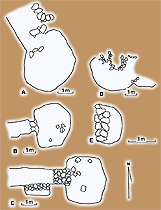
Naxos, Kamini. Plans of chamber tombs.
|
||
 |
||
|
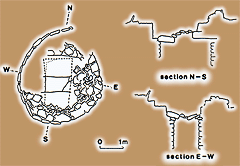
Keos, Agia Irini. Plan and section of cist grave 40.
|
||
 |
||
|
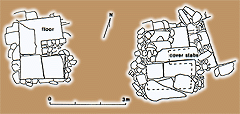
Keos, Agia Irini. Plan and section of cist grave 58.
|
||