 |
||
There is no archaeological evidence from the Early Bronze Age related to cult practices. Only the production of the Cycladic figurines and their deposition in graves could be connected with certain religious beliefs of the population; actually with the realization of cult customs in combination with burial customs. The religious elements from the period of the Middle Bronze Age are even less as the figurine production ceases at that time. But during exactly this period the earliest sanctuary of the prehistoric Aegean is founded in Agia Irini on Keos, an important fact that marks the formation of the cult customs of the Late Bronze Age. The cult customs on the Aegean islands during the early periods of the Late Bronze Age are apparent in the rich iconography of the frescoes of Thera. In these representations, which however reflect mostly the cult customs of Minoan Crete, members of the priesthood and worshipers are often depicted in ritual acts and ceremonies of initiation of young persons. From the middle of the Late Bronze Age we have a great number of evidence on the cult, which come mainly from the mature phases of the use of the sanctuary at Agia Irini and from the sanctuary at Phylakopi on Melos. These two insular sanctuaries enrichen our knowledge on the Mycenaean cult in general, as there are no satisfactory elements on the cult in particular rooms from the mainland, except for the sanctuaries of Mycenae, Tiryns and Asine. The archaeological finds of the sanctuaries (figurines and cult vessels) which are identical with those of mainland Greece, give the impression that the cult on the islands continued completely integrated in the ritual of the Mycenaean religion. |
 |
|
|
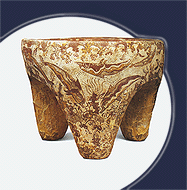
Thera, Akrotiri. Tripod table of offerings
with dolphin representation. |
||