 |
||
The Aegean sea, the sea studded with small and big islands, that the ancient Greeks named after its huge waves, the so-called aiges, constituted a region that attracted people already from about the 11th millenium BC but was inhabited systematically not until the Neolithic Age (6800-3200 BC). In the Bronze Age (3200-1050 BC) this sea is the water band that connects mainland Greece with Asia Minor, Crete and the south Aegean with the northern Helladic region, the Balkans and the Black Sea thus constituting the field of intense economic, social and cultural activities in general. The quest and discovery of metals (copper, silver, lead) in the Cyclades and the use of durable bronze - alloys from Asian sources brought about decisive changes in metalworking, improvement of agricultural production and gave an impetus to manufacture and trade from the beginning of the 3rd millenium. The islands of the northeastern Aegean, in which populous settlements with early urban features are developed, play a primary role in the diffusion of the bronze know-how in the central and south Aegean. The archaeological remains of Poliochni on Lemnos are identified with the most ancient town of Europe with democratic structures which are visible in the existence of a communal assembly area, the so-called "Bouleuterion". The contribution of the Cyclades in the development of navigation, the definition of new sea routes and the creation of trade networks through which the mainland and coastal Greece, Asia Minor and the islands are connected, creating from about the middle of the 3rd millenium a common culture which is appositely described with the term "international spirit" is decisive. In the Middle Bronze Age (2000-1550 BC) the experienced seamen of the Cyclades join forces with the great economic power of that period, Minoan Crete, they acquire wealth and organize the first large settlements which, despite the successive natural disasters, survive and evolve into powerful urban centres in the Late Bronze Age (1550-1050 BC). During the Late Cycladic I period, Akrotiri on Thera is the only cosmopolitan centre in which elements of Minoan Crete (architecture, frescoes, cult) and of the rising Mycenaean world coexist in an intense Cycladic climate. The eruption of the volcano of Thera (1628 BC), the increase of the Mycenaean power and the destruction of the Minoan palaces (about 1450 BC) mark a new cultural period on the Aegean islands. The inhabitants of the Cyclades are still in the limelight, now in cooperation with the Mycenaeans in marine transit trade. The influence of the Mycenaeans reaches up to the northeastern Aegean (Lemnos). But, the effect of the Mycenaean civilization becomes even more powerful and is obvious in architecture (fortifications), administrative organization (megara), religion (sanctuaries), burial customs and in the art mainly of the Cyclades and the islands of the south Aegean.
|
 |
|
|
The most important sites of
the Early Bronze Age in the Aegean. |
||
 |
||
|
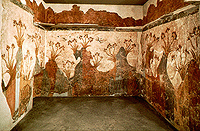
Thera, Akrotiri. The "Springtime Fresco".
|
||