 |
||
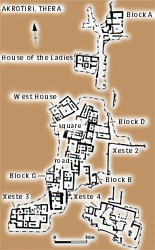
The island that marked decisively the evolution of the Late Bronze Age cultures is Thera which is situated on a volcanic crater. A colossal volcanic destruction which occurred at the end of the Late Cycladic IA period created a large crater sinking the central part of the island into the sea and forming the three islands of today: Thera, Thirasia and Aspronisi. Some researchers associate the sinking of Thera with the legendary Atlantis which Plato mentions in his work Politeia. With the existent dating the eruption dates to 1500 BC. However, new datings, based on archaeometric surveys, place the eruption more than one centuries earlier, around 1628 BC. The application of the new chronology which has not been approved by all the researchers reverses the existent archaeological evidence and mainly the correlations of the Cycladic with the other Late Bronze Age cultures. After the eruption the prehistoric settlements were covered by layers of volcanic tephra which sometimes reaches 60 metres thick. At the site Akrotiri at the south end of the islands, the excavations revealed under the layers of tephra an extensive settlement of the Late Cycladic I period which was destroyed by the eruption. The limits of the settlement have not yet been found but it is estimated that it occupies 200 hectares. The settlement remains of the excavated part are in a perfect state of preservation and thus give us a credible picture of the settlement plan. The buildings -two or three-storey ones- were built in insulae, they had a sewage system, roads and squares. The perfect construction and the luxury of the installations leads to the conclusion that rich merchants or regional chiefs lived there whereas some buildings have been characterized as cult centres because of the ritual religious installations, the decoration and the particular finds. The architectural planning and the construction of the buildings correspond absolutely to the picture we have of the Minoan settlements, thus reinforcing the view that although Akrotiri was not inhabited by Minoans, it was in the nearest sphere of Minoan influence. The life of the settlement ceased unexpectedly a little before the eruption when the inhabitants abandoned it, warned obviously by the strong earth tremors. It seems that they took with them only their necessary possessions. Therefore, numerous objects (vases, tools, and furniture) were found in the buildings in situ. Among the other finds a large number of frescoes of exceptional quality which decorated the internal walls of the buildings were found. The frescoes of Akrotiri with their live representations reveal many aspects of the everyday life, the customs and cult of an insular Late Bronze Age town. The richness of the finds and the fact that these belong to a particular time before the volcanic destruction are the reasons for which Akrotiri is considered as the "Pompeii of the prehistoric Aegean". |
 |
|
|
Thera, Akrotiri. Plan of the settlement.
Late Cycladic I. |
||
 |
||
|
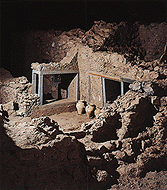
Thera, Akrotiri.
View of the eastern side of sector Delta. |
||