 The abundant finds from Minoan Crete provide information
on the changes in Minoan society in each Minoan period.
Settlements, cemeteries and works of art reveal the rapid evolution
of a geographically confined society which was not only receptive to foreign influence,
but also managed its resources appropriately and developed a great civilization.
The abundant finds from Minoan Crete provide information
on the changes in Minoan society in each Minoan period.
Settlements, cemeteries and works of art reveal the rapid evolution
of a geographically confined society which was not only receptive to foreign influence,
but also managed its resources appropriately and developed a great civilization.
During the Early Minoan period (3000-2000 BC) for the first time collective works, the technical specialisation of social groups and social ranking appear as a result of foreign commercial relations and the successful exploitation of raw materials (most likely by specific social groups). During this period social consciousness was reinforced and a ruling class was established, leading to the foundation of the palaces.
During the Middle Minoan period (2000-1550 BC),
along with the appearance of the palaces (which apart from being a distinct
settlement system were also the axis of central power) Minoan society
underwent radical changes and appears organized and
centralized. The internal organization of the palatial centres demanded the
clearly defined social classes in a clear hierarchy.
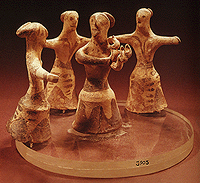 The character of the palace administration allows the definition of this society as
theocratic since the concentration of power (which was certainly exercised by
the palaces) was attended by a dominant religion. However, the boundaries
between politics and religious power still remain vague
since conclusions for the most part of the
Palatial period are based on archaeological finds
unsupported by written evidence. Moreover, although
the mythological tradition of the
Cretan King Minos influenced the interpretation of archaeological evidence
for a long time, the latest research has indicated problems in identifying
the leading figures in Minoan Crete.
The character of the palace administration allows the definition of this society as
theocratic since the concentration of power (which was certainly exercised by
the palaces) was attended by a dominant religion. However, the boundaries
between politics and religious power still remain vague
since conclusions for the most part of the
Palatial period are based on archaeological finds
unsupported by written evidence. Moreover, although
the mythological tradition of the
Cretan King Minos influenced the interpretation of archaeological evidence
for a long time, the latest research has indicated problems in identifying
the leading figures in Minoan Crete.
The Mycenaeans introduced an administrative organization similar to that of Mycenaean Greece, including the archive organization system and the creation of certain new military institutions as proved by the luxurious warrior graves. During the Post-Palatial period (1400-1050 BC) social developments that usually result from the enfeeblement of central power took place. Power is now exercised by several leaders who probably lived in rural villas and controlled smaller regions.
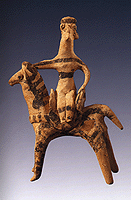 At the end of the Bronze Age power is exercised on a limited geographic scale
whereas the specialized groups which served the government machinery
have disappeared. The lack of central power leads to an increasing participation of
the urban centres in power.
Moreover, the phenomenon of administrative independence affecting
religious organization are observable. The choice of new settlement locations in
naturally fortified regions indicates insecurity on the part of the inhabitants,
most likely attributable to a waning central power.
At the end of the Bronze Age power is exercised on a limited geographic scale
whereas the specialized groups which served the government machinery
have disappeared. The lack of central power leads to an increasing participation of
the urban centres in power.
Moreover, the phenomenon of administrative independence affecting
religious organization are observable. The choice of new settlement locations in
naturally fortified regions indicates insecurity on the part of the inhabitants,
most likely attributable to a waning central power.
Throughout the Minoan period there is no defense system comparable to the citadels of the Bronze Age in the Aegean and mainland Greece, which indicates that the security of the inhabitants was ensured for most of the Bronze Age by the so-called Minoan Peace.