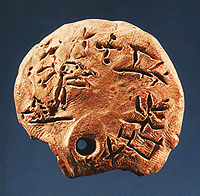
 Hieroglyphic or pictographic script was used in Crete during the Middle Minoan period
(2000-1550 BC). This writing system was made up of ideograms,
that is icons representing meaning in both a direct and abstract way.
Examples of this script are restricted to a small number of brief texts.
So far only numbers have been deciphered, revealing that a decimal
system was already in use. As for the other symbols, it appears that
some signs are phonetic, rendering the phonemes, or the units of sound, of speech.
Hieroglyphic or pictographic script was used in Crete during the Middle Minoan period
(2000-1550 BC). This writing system was made up of ideograms,
that is icons representing meaning in both a direct and abstract way.
Examples of this script are restricted to a small number of brief texts.
So far only numbers have been deciphered, revealing that a decimal
system was already in use. As for the other symbols, it appears that
some signs are phonetic, rendering the phonemes, or the units of sound, of speech.
Hieroglyphic inscriptions occur on stone seals, clay tablets, roundels and quadrangular bars. Seals bearing hieroglyphic script are accidental finds while clay inscriptions are concentrated in the "hieroglyphic deposit", in the west court of the palace. The fact that the signs on the seals are scored so deeply is probably due to the hardness of the material.