 

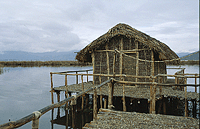
The prehistoric settlement of Dispilio is situated at the site Nisi, on the southern shore of Kastoria lake. It was located in 1932, when the lake level fell, and at the point where Nisi was separated from the lakeshore, remains of wooden posts became visible. Systematic excavations (1992 onwards) unearthed the remains of a large lakeside settlement of the Late Neolithic; one of the most important and oldest of its kind in Europe. Excavations of lakeside settlements started in 1854 at Bodensee, South Germany, and were then taken up in central and western Europe enabling researchers to develop special methods of excavation and conservation techniques. Excavations at Dispilio constitute a landmark for archaeological investigations in Greece because of the special character of the site and because it permits the study of habitation structures during the Neolithic Period. |
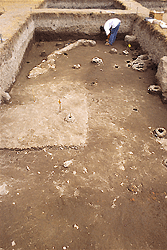
The houses of the settlement, circular and rectangular, were built of timber, reed and clay upon timber-post framed platforms. The modern reconstruction of the lakeside settlement which has been programmed and is expected to extend over a surface area of 150,000 square metres approximately, will provide a wonderful insight into the habitation norms of that period. Among the fauna and flora remains as well as the mobiliary finds from
the excavations (pottery, tools, etc.), the whole range of economic
activities of the prehistoric inhabitants of Dispilio are represented:
farming, animal husbandry, hunting and fishing. Numerous bone hooks
and traces of a boat, identical to those used to this day by the fishermen
of Kastoria, is clear evidence that fishing was practised. Finds such
as leaf-shaped and triangular arrow heads of Melian obsidian, pottery
similar to that of the neighbouring Balkan areas and a stone ring idol
pendant, place the settlement of Dispilio within the exchange networks
developed in Greece in particular during the Late Neolithic. |