
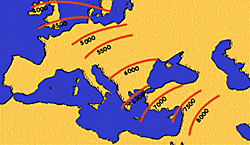
The transition from the hunting and food-gathering stage of the Palaeolithic
and Mesolithic to the productive stage of the Neolithic Period was marked
by the organization of settlements with a permanent character and the
systematic practice of farming and stock-rearing. The transition process
to the so-called Neolithic way of production (Neolithization) took place
in the Aegean in the first half of the 7th millenium BC, earlier than
in the Balkans and the rest of Europe.
Archaeological data, particularly flora and fauna remains as well
as stone tools, from the few settlements of the Pre-Pottery Neolithic
have puzzled archaeologists as to the origins of the productive way
of life in Greece. The main views regarding this issue are summarized
as follows:
1. The transition took place in Greece, it was in other words indigenous,
and has been confirmed by settlements of a permanent character situated
at Yioura in the North Sporades, at Maroulas on Kythnos, and Franchthi
in Hermionid, where, besides the building remains, burials of members
of the first small communities have been observed. These sites date
to the Mesolithic Period and are associated with specialization in fishing,
with primitive cultivation
and milling of wild forms of cereals (Franchthi, Theopetra) and domestication
of wild animals (wild boar at Yioura).
2. Neolithic economy was introduced in the Aegean from Asia Minor, where
it had been adopted a little earlier. This theory bases its arguments
on the small number of sites of the Pre-Pottery Neolithic, traced in
the eastern part of the Greek mainland (Argissa, Sesklo, Franchthi,
Knossos), stone tools corresponding to those of the settlements in Asia
Minor and the presence of domestic
sheep and goats, whose wild forms did not exist formerly in Greece.
In this theory the Aegean Islands play an important role.
3. Greece participated -to the extent the geomorphology, climate, wild
fauna and flora of the area made this feasible- in the process of transition
to the Neolithic way of life that began around 9000 BC, in the Near
East. Recent investigations in the Near East, Asia Minor and the Aegean
have added new data that refute the earlier view about a nuclear zone
in the Near East ("fertile
crescent"), where the productive stage of the economy was established
and disseminated to the west. The finds of the Mesolithic
Period in Greece mentioned above are links in a long chain of the quest
for the origins of agriculture and animal husbandry. The conquests of
the Mesolithic were reinforced and enlarged with the contacts taking
place either via the Aegean islands or Thrace.
|